Aug 23, 2018 | Ecosystems, Food
© Huating | Dreamstime.com
By Sandra Ortellado, 2018 Science Communication Fellow
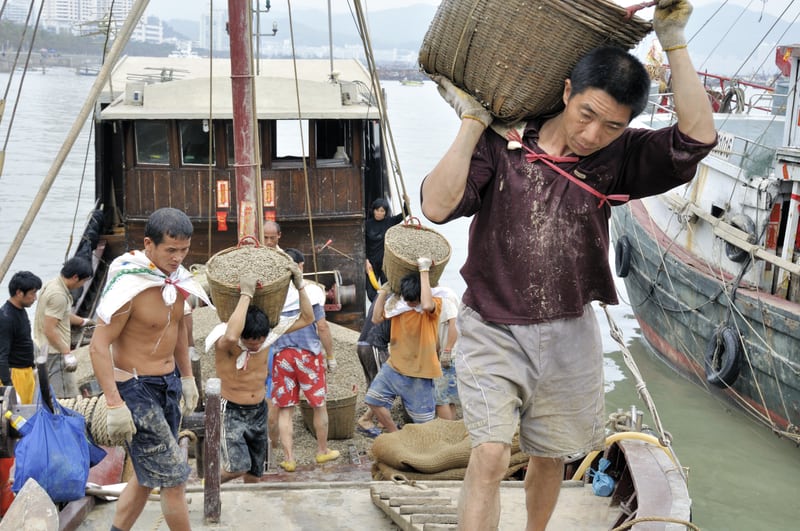
China is the world’s biggest producer of both wild and farmed fish, yet the massive commercial fishing industry threatens thousands of years of tradition in ocean and freshwater fishing, as well as the livelihoods of coastal fishing communities.
In the past decade, some coastal ecosystems and environments have been destroyed and polluted in the process of industrialization. Millions of tons of fish are caught in Chinese territorial waters each year, such that overfishing of high value commercial species has led to a drastic decline of some native fisheries resources and species.
In response, the Chinese government released a five-year plan for protecting marine ecosystems and restoring wild capture fisheries. The plan promotes an agenda of “ecocivilization,” which emphasizes land–sea coordination, green development, and social–ecological balance.
It also calls for the introduction of additional output control measures, which directly limit the amount of fish coming out of a fishery. Existing input control measures restrict the intensity of gear used to catch fish, but they may not be sufficient to protect ecosystems.
Yi Huang, a member of this year’s YSSP cohort, has made it her goal to figure out how social ecological balance can be achieved even as fishery regulations shift towards increased input and output control.
Given the size of China’s fishing industry, large scale change requires the abstract concepts of “ecocivilization” to be translated into action, compliance, and enforcement at the local level. That means engaging with individual fishers, their communities, and their way of life, says Huang.
“If you want to control overfishing; the object of fishery management policy are fishers. So you need to understand human behavior to help you control overfishing.”
Huang’s project investigates how changes in fishery management will affect demographic, geographic, and socioeconomic trends in the Chinese fisher population. With the guidance of her supervisors, she’s also developing a bioeconomic model to analyze how output control measures like catch limits will affect ecological and socioeconomic conditions.
“I just want to figure out how to improve enforcement of this kind of policy and see if we can use it to solve the overfishing problem at the same time as giving those in the fishing industry a better life,” says Huang.
Current input control measures like licensing systems, vessel buyback programs, closed seasons, restricted areas, and fisher relocation programs are meant to discourage overfishing and transition towards more sustainable practices. Nevertheless, a decline in fishing vessels and restricted fishing seasons only resulted in an increase in total vessel engine power and large spikes in fishing activity just prior to the closed season.
According to the Chinese fishery statistical yearbook, the number of people employed in the fishing industry proliferated to 13.8 million in 2016, so in recent years the government has issued subsidies encouraging fishers not to fish in the off-season and to change vocation. Older fishers are hesitant to abandon an identity that has been passed down from generation to generation in their families. However, younger generations with access to higher education are lured by the prospect of more stable work outside of their fishing communities, which could really change the socioeconomic and demographic structure of coastal villages.
With the potential for increased output controls to incur drastic changes in coastal communities, it’s more important than ever that regulations are carefully designed with both socioeconomic and ecological factors in mind.
Huang hopes her research will help inform the process of policy development, which involves balancing the needs of both vulnerable fisheries labor and delicate ecosystems.
“When policymakers want to use output control in fishery management, maybe they will think more about the fisher or the socioeconomic aspect of the resolution,” says Huang.
“My research is at the national level, but when they design a regulation it’s at the local level, so my research can teach them how socioeconomic surveys at the local level can be used together with ecological research when they are preparing for regulations.”
Huang, who studied sociology at the Ocean University of China before starting as a PhD student in Marine Affairs at Xiamen University, has spent the past ten years researching coastal fishing communities. She has a deep fondness for the people she surveyed, who welcomed her into their homes and showed her the beauty of the environment that sustained them.
“I want to protect the ocean and the people that connect with it,” says Huang.
A sociological perspective has given Huang an eye for nuance and an appreciation for things that don’t turn out quite how you expect, as they often don’t in scientific research—especially when it attempts to explain human behavior.
For example, Huang says that although fishers may look like countryside people, they act very differently from farmers.
“The ocean has a lot more risk involved than planting on land,” explains Huang.
Because Chinese fishery regulation is currently focused almost exclusively on analyzing resources from an ecological perspective, she thinks sociology and anthropology research could add another revealing dimension to the approach.
“After doing surveys and analyzing the data, I will find maybe I’m wrong or maybe there is something more. That’s why I’m really interested in this kind of research,” says Huang.
As her research project develops, Huang says she’s grateful for the feedback of her supervisors and peers at IIASA, who both challenge and encourage her.
“Even when they have some critical comments on my research, I feel more confident that my research is meaningful, that they support me, and that they’re really interested in my research,” says Huang. “That’s what I can feel every day.”
Aug 10, 2018 | Demography, Education, Risk and resilience, Young Scientists
© SasinTipchai | Shutterstock
By Sandra Ortellado, 2018 Science Communication Fellow
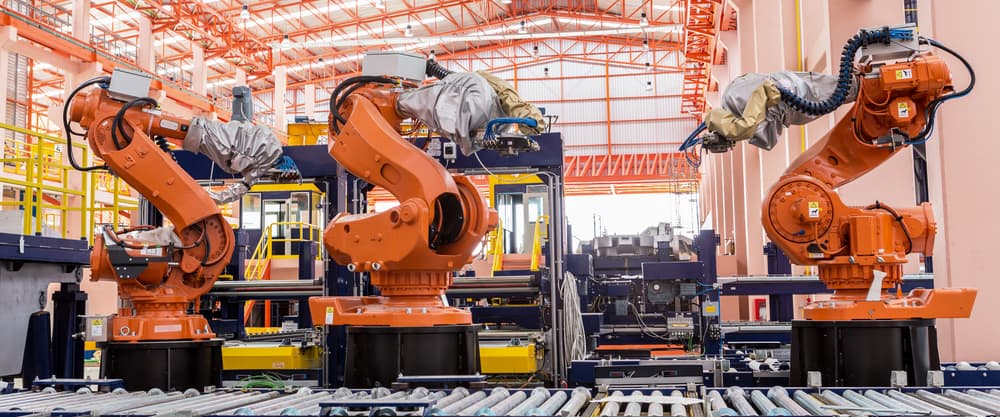
Science fiction depicts the future with a combination of fascination and fear. While artificial intelligence (AI) could take us beyond the limits of human error, dystopic scenes of world domination reveal our greatest fear: that humans are no match for machines, especially in the job market. But in the so-called fourth industrial revolution, often known as Industry 4.0, the line between future and fiction is a thread of reality.
Over the next 13 years, impending automation could force as many as 70 million workers in the US to find another way to make money. The role of technology is not only growing but also demanding a completely new way of thinking about the work we do and our impact on society because of it.
Rather than focusing on which jobs will disappear because of technological disruption, we could be identifying the most resilient tasks within jobs, says J. Luke Irwin, 2018 YSSP participant. His research in the IIASA World Population program uses a role- and task-based analysis to investigate professions that will be most resilient to technological disruption, with the hope of guiding workforce development policy and training programs.
“We are getting better and better at programming algorithms for machines to do things that we thought were really only in the realm of humans,” says Irwin. “The amount of disruption that’s going to happen to the work industry in the next ten years is really going to impact everyone.”
However, the fear and instability created by the potential disruption elicit chaos, and the response is hard to organize into constructive action. While the resources remain untapped, creativity and imagination are wasted on speculation instead of preparation.
“I couldn’t stand that there’s all this great evidence-based work out there about how we can improve people’s lives and no one is using it,” said Irwin, “I’m trying to align a lot of research and put it in a place where you can compare it and make it more useful and more transferable between the people who would be talking about this: educators, policymakers, employers, and anybody in the workforce.”
Using a German dataset with vocational training as well as time and task information, Irwin will break down jobs into the specific cognitive and physical skills involved and rank the durability of each skill.
Based on the identified jobs and skills, Irwin will go on to draw connections between labor-force capabilities and education policies. His goal is to scale the findings of the most resilient skills to the German labor system so that policymakers and academic institutions can retrain currently displaced workforces and reimagine the future of human work.
After all, while about half the duties workers currently handle could be automated, Mckinsey Global Institute suggests that less than 5% of occupations could be entirely taken over by computers. The future of predictable, repetitive, and purely quantitative work may be threatened, but automation could also open the door for occupations we can’t even imagine yet.
“I think people are amazing and that they have a lot more potential than we are currently capable of fulfilling,” says Irwin.
The World Economic Forum estimates that 65% of children today will end up in careers that don’t even exist yet. For now, an increasingly self-employed millennial generation works insecure, unprotected jobs. The new gig economy, characterized by temporary contracted positions, offers independence but also instability in the labor market.
Without stable work, people lose a sense of security, and that can be dangerous for a policy system that isn’t built to handle uncertainty.
The last industrial revolution caused two or three generations of people to be thrown into poverty and lose everything they had because it was all tied into their job, recalls Irwin.
“Everything gets bad when things are uncertain,” says Irwin, “And this is a very uncertain time. We need to have a better idea of what’s coming so we can actually make some change.”
Irwin, who earned his Master’s in Public Health in 2014, wants his work to have a preventative focus, trying to find those things that not enough people are talking about, but have the potential to make a huge impact on public well-being.
“Especially in the United States, where I live, we’re so tied up with our jobs—it seems like it’s over half our identity,” says Irwin, “We live to work in America.”
In a place like the US, where a job is not only a source of income, but also an identity and a health factor, Irwin’s research offers hope that technological disruption can foster opportunity instead of chaos.
Note: This article gives the views of the authors, and not the position of the Nexus blog, nor of the International Institute for Applied Systems Analysis.
Aug 7, 2018 | Data and Methods, Risk and resilience, Women in Science, Young Scientists
by Melina Filzinger, IIASA Science Communication Fellow
Having just finished tenth grade, Lillian Petersen from New Mexico, USA is currently spending the summer at IIASA, working with researchers from both the Ecosystems Services and Management (ESM), and Risk and Resilience (RISK) programs on developing risk models for all African countries.
At a talk Petersen gave at the Los Alamos Nature Center/Pajarito Environmental Education Center, her method for predicting food shortages in Africa from satellite images caught the attention of Molly Jahn from the University of Wisconsin-Madison. Jahn, who is collaborating with the ESM and RISK programs at IIASA, was so impressed with Petersen’s work that she added her to her research group and connected her to IIASA researchers for a joint project.
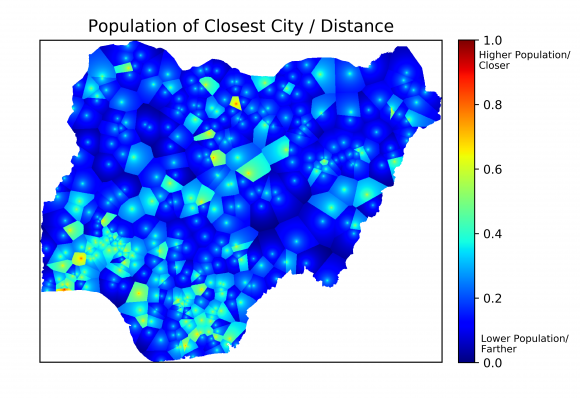
One of the indicators used to estimate poverty in Nigeria. © Lillian Petersen | IIASA
Knowing which areas are at risk for disasters like conflict, disease outbreak, or famine is often an important first step for preventing their occurrence. In developed countries, there is already a lot of work being done to estimate these risks. In developing countries, however, a lack of data often hinders risk modeling, even though these countries are often most at risk for disasters.
Many humanitarian crises, like famine, are closely connected to poverty. However, high resolution poverty estimates are only available for a few African countries. This is why Petersen and her colleagues are developing methods to obtain those poverty estimates for all of Africa using freely available data, like maps showing major roads and cities, as well as high-resolution satellite images. Information about poverty in a certain region can be extracted from this data by considering several indicators. For example, areas that are close to major roads or cities, or those that have a large amount of lighting at night, meaning that electricity is available, are usually less poor than those without these features. The researchers are also analyzing the trading potential with neighboring countries, the land cover type, and distance to major shipping routes, such as waterways.
As no single one of these indicators can perfectly predict poverty, the scientists combine them. They “train” their model using the countries for which poverty data exists: A comparison of the model’s output and the real data helps to reveal which combination of indicators gives a reliable estimate of poverty. Following this, they plan to apply that knowledge in order to accurately predict poverty with high spatial resolution over the entire African continent.
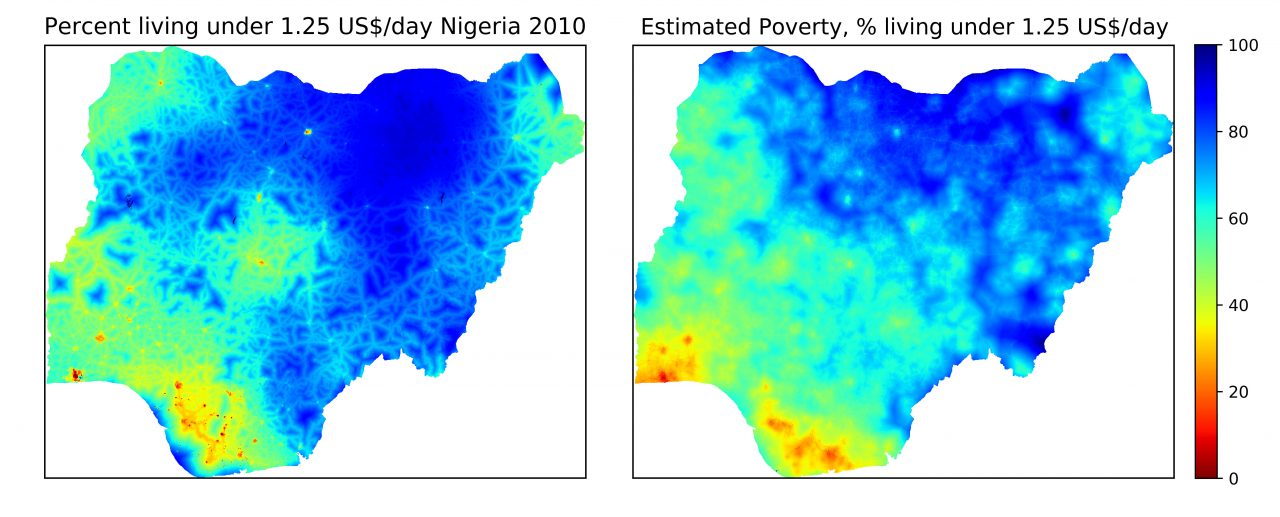
Poverty data for Nigeria in 2010 (left) and poverty estimates based on five different indicators (right). © Lillian Petersen | IIASA
Once these estimates exist, Petersen and her colleagues will apply risk models to find out which areas are particularly vulnerable to disease outbreaks, famine, and conflicts. “I hope that this research will inform policymakers about which populations are most at risk for humanitarian crises, so that they can target these populations systematically in aid programs,” says Petersen, adding that preventing a disaster is generally cheaper than dealing with its aftermath.
The skills Petersen is using for her research are largely self-taught. After learning computer programming with the help of a book when she was in fifth grade, Petersen conducted her first research project on the effect of El Nino on the winter weather in the US when she was in seventh grade. “It was a small project, but I was pretty excited to obtain scientific results from raw data,” she says. After this first success she has been building up her skills every year, by competing at science fairs across the US with her research projects.
Her internship at IIASA gives Petersen access to the resources she needs to take her research to the next level. “Getting feedback from some of the top scientists in the field here at IIASA is definitely improving my work,’’ she says. Petersen is hoping to publish a paper about her project next year, and wants to major in applied mathematics after she finishes high school.
Note: This article gives the views of the author, and not the position of the Nexus blog, nor of the International Institute for Applied Systems Analysis.
Aug 3, 2018 | Arctic, Climate, Climate Change, Communication, Education, Science and Policy, United Kingdom

© Vadim Nefedoff | Shutterstock
By Sandra Ortellado, 2018 Science Communication Fellow
Around 8,000 kilometers away from Vienna, Austria, hundreds of Arctic coastal communities are at imminent risk from the melting ice and coastal erosion. Indigenous Arctic populations struggle with food insecurity every day, living off small fractions of what their catch would have been only a few years ago. Their culture and their way of life, so dependent on sea ice conditions, are melting away, along with the very root of the Arctic ecosystem.
However, construal level theory, a social psychological theory that describes the extent to which distant things become abstract concepts, tells us that 8,000 kilometers is just far enough for Arctic peoples to lose tangible existence in the minds of urban citizens. Unlike Arctic communities, who experience the direct effects of climate change at each meal, commercialized lower latitude societies don’t have to face the environmental consequences of choosing to drive to the grocery store instead of bike.
Nevertheless, those consequences are very real, even if the impacts on the Arctic and climate system don’t always catch our attention. Sea level will continue to rise for the next several hundred years—it takes 500 years for the deep ocean to adjust to changes at the surface.
On Friday, 22 July, former Chief Scientist of the UK Met Office Dame Julia Slingo and former Chair of the IIASA Council Peter Lemke joined us at IIASA for a joint lecture on climate risk in weather systems and polar regions. The lecture had one underlying theme: in order to make informed decisions on climate change, we need to embrace uncertainty with a broader understanding of what’s possible. That means that the far-away Arctic needs to be seen as nearby and relevant, and that climate change forecasts once seen as ‘uncertain,’ should instead be interpreted as ‘probable.’
“People are often confusing uncertainty with risk. If it’s uncertain they think they don’t really have to think about it. But there is a risk they take if they avoid things,” says Lemke. “a 40% chance could also mean a doubling of the risk, and a doubling of the risk is something that’s easily understood.”
“It’s a matter of how you communicate it,” says Lemke.
Perhaps Hollywood’s obsession with apocalyptic disaster narratives serves some kind of purpose after all—the stories seem outlandish, but films translate them into concepts we can understand and scenes we’re familiar with. It’s hard to picture what it would be like to live in a world that is 2°C warmer, but thanks to Hollywood special effects, we can picture what it would be like if storms of epic proportions engulfed the Statue of Liberty in a gigantic tidal wave.
“We have get down to people’s personal experience. That’s why I’m so against the use of things like global mean temperature, because people can’t relate to that,” says Slingo. “I am very keen on using narrative, but based on science, so people have access to the evidence for why we have this story that we tell about how climate change could affect them personally.”
Of course, we can’t give Hollywood too much credit: these stories are dangerously lacking input from actual climate science. Nevertheless, armed with the forecasting tools and technologies that have advanced so much over the past decade or so, we can counter uncertainty and get a better understanding of the risks we face. For example, using improved computer models and satellites that determine the age and thickness of ice, we can determine the rates of receding ice, and how much that will affect sea level rise in coastal communities.
Likewise, social media makes it easy to transmit information rapidly to a large audience that might not have been reachable otherwise. Reaching people where they are is of paramount importance—while scientists can put painstaking effort into presenting the most accurate, unbiased account of probable risks, this is just one facet of any given decision. In the end, it is the public and the policymakers that represent them that must make the decision about what actions to take, based on a complete narrative that includes the socioeconomic and cultural factors involved.
“It’s all about dialogue at the end of the day. One of the things I learned as MET office chief scientist was that based on the evidence I was giving to government, you would think that the policy would be quite clear,” says Slingo. “But there are other aspects to take into consideration, such as unemployment or other policy implementation capacities and societal implications.”
That’s why Lemke and Slingo both make huge efforts to communicate with the public, especially with the impressionable, optimistic, social media savvy and politically mobilizing younger generations. From their interactions and outreach with the public, Lemke and Slingo know that once you put climate change in proximity and translate science into narratives that are relevant to the lives of individual citizens, the public does care about climate change. They want to know more, and they want to do something about it.
When it comes to environmental advocacy, education is power, especially when it translates the high-end risk probabilities of climate science into relatable narratives. For Lemke and Slingo, that creates a huge opportunity for scientists of all backgrounds.
“I don’t think climate change has to be depressing. It’s a fantastic opportunity for a whole generation of scientists and engineers to tackle a great problem,” says Slingo. “I actually have the confidence that we’ll solve it.”
Jul 31, 2018 | Data and Methods, Young Scientists
by Melina Filzinger, IIASA Science Communication Fellow
Strategic board games are staple entertainment for families all over the world, but what many do not know is that games can also be a valuable research tool. As her project for the Young Scientists Summer Program (YSSP), Sara Turner is piloting an experiment that uses a game called the Forest Game, developed by IIASA and the Centre for Systems Solutions, to find out how policy decisions are made and how they change over time. “Games let you abstract from the specifics of a real-world case, but are more human-centric than, for example, computer simulations,” says Turner.
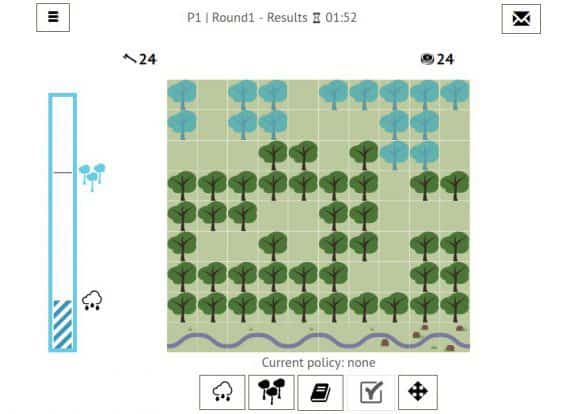
Interface of the Forest Game, © IIASA
In the Forest Game, a group of five to ten players is asked to make decisions about the management of a forest together. Harvesting trees yields returns for the players, while harvesting too many of them might destroy the forest or increase the risk of flooding. There are some uncertainties in the game – for example, the players do not know exactly how resilient the forest is. The goal of the research project is to run multiple iterations of the game with different players and starting conditions, and trace how group discussions and the resulting decisions change over time. This helps to generate hypotheses about the ways in which individuals interact to generate policy outcomes. Each game takes about an hour to play.
Even though the Forest Game deals with forest management, this is only one example of a broader class of decision-making dilemma: when a resource is limited, and it is costly to prevent access, people will tend to over-exploit the resource. This in turn leads to a wide range of problems, from over-fishing to air pollution. Although games cannot capture the complexity of real situations, they can still help us understand the core dynamics of the problem and develop ideas and strategies that are relevant to solving it. “The game is not designed to be directly applicable to real life, but it helps to come up with hypotheses that you can then compare to real-life cases,” explains Turner.
Questions about the sustainable management of resources have been studied for decades, but not a lot is known about the role values play in shaping group decision making and the stability of the implemented policies. To investigate this, each participant is asked to fill out a short ten-minute survey assessing their core values and beliefs, after which they are put into a group with people who either have a very similar or very different worldview from them. “It is really interesting to put a person in a decision-making context with other people and get some insight into how they work through that problem,” says Turner.

© Sara Turner
For example, if you are a person that strongly values equality, in the game you might be likely to argue in favor of a policy where all participants obtain the same amount of returns, regardless of the number of trees the individual player chooses to harvest. If many players in the group share your belief, that policy might be more likely to be implemented than in a very diverse group.
Another interesting question whenever you run a game for research purposes is, “Who are the right players?” Some games are targeted at real-world policymakers, but often games can also be educational for the broader public. ‘’People learn a lot during games, because of the way that information is processed and experienced,” says Turner. That is why many participants, although they might not see a connection between the game and their life at first, find themselves relying on the insights they gained while playing when faced with similar situations in the future.
In this case, the goal is to study group decision-making processes in general, so the details of who is playing are not particularly important. However, to obtain groups of players with heterogeneous worldviews, a high degree of diversity is preferable.
While the game has previously mainly been played by YSSP participants and students of the University of Vienna, Turner is currently trying to recruit a more diverse set of players from both within and outside of IIASA. “It would be ideal to have a pool of participants who come from a wide variety of educational and cultural backgrounds,” she says.
If you are interested in participating in the Forest Game, you can write Sara Turner an e-mail to [email protected].
Note: This article gives the views of the authors, and not the position of the Nexus blog, nor of the International Institute for Applied Systems Analysis.

You must be logged in to post a comment.