By Marcus Thomson, IIASA alumnus and a researcher at the National Center for Ecological Analysis and Synthesis (NCEAS), the University of California, Santa Barbara
IIASA alumnus Marcus Thomson explains how what we have learnt about prehistoric farming cultures can be used to provide useful insights on human societal responses to climate change.
The climate of the western half of the North American continent, between the Rocky Mountains and the Pacific coastal region, is dry by European standards. The American Southwest, in particular, centered roughly on the intersection of the states of Colorado, New Mexico, Arizona, and Utah, is predominantly desert between high mountain plateaus. It is, and has always been, a challenging environment for farmers. Yet the prehistoric Southwest was home to complex maize-based agricultural societies. In fact, until the 19th century growth of industrial cities like New York, the Southwest contained ruins of the largest buildings north of Mexico — and these had been abandoned centuries before the Spanish arrived in the Americas.
For more than a century, researchers have pored over data, from proxies of paleo-environmental change, to historiographies collected by explorers, to archaeology and computational models of human occupation, and produced a detailed picture of the socio-environmental, economic, and climatic conditions that could explain why these sites were abandoned. While details vary in fine-grained analyses of the various sub-groupings of peoples in the region, the big picture is one of societal transformation in adapting to climate change.
Also important is just how the climate changed during the period, because similar dynamics are expected to emerge in the future as a consequence of global warming. European historians point to a medieval era with generally warmer mean annual temperatures. In the Southwestern United States however, which is more sensitive to changes in drought than temperature, the period between roughly AD 850 to 1350 is known as the Medieval Climate Anomaly (MCA). The warm, dry MCA was followed by a long stretch of increased changes in the availability of water, known as the Little Ice Age (LIA). More frequent “warm droughts” at the end of the MCA, and generally increasing changes in water resources at the onset of the LIA, is thought to be a good analogy for future conditions in western North America.
When I had the good fortune to visit IIASA as a participant of the Young Scientists Summer Program (YSSP) in 2016, I worked with research scholars Juraj Balkovič and Tamás Krisztin to develop a model of ancient Fremont Native American maize. The Fremont were an ancient forager-farmer people who lived in the vicinity of modern Utah. We used a climate model reconstruction of the temperature and rainfall between AD 850 and 1450 to drive this maize crop model, and compared modeled crop yields against changes in radiocarbon-derived occupations – in other words, the information gathered from carbon dated artifacts that show that an area was occupied by a particular people – from a few archaeological areas in Utah.
Among our findings was that changes in local temperatures appeared to play a larger role in the lives, practices and habits of the people who lived there than changes in regional, long-term temperature conditions [1]. Later, while a researcher at IIASA myself, I returned to the subject with one of our coauthors, professor Glen MacDonald of the University of California, Los Angeles, using an expanded geographic range and a more sophisticated treatment of radiocarbon dated occupation likelihoods.
We used the climate model to reconstruct prehistoric maize growing season lengths and mean annual rainfall for Fremont sites. We found that the most populous and resilient Fremont communities were at sites with low-variability season lengths; and low populations coincided with, or followed, periods of variable season lengths. This study confirmed the important dependence on climate variability; and more importantly, our results are in line with others on modern smallholder farming contexts.
More details on our latest study [2] have just been published online in Environmental Research Letters (ERL). It will become part of an ERL special issue looking at societal resilience drawing lessons from the past 5000 years. Studies like these can give useful insights on human societal responses to climate change because these ancient civilizations are, in a sense, completed experiments with complex human-environmental systems. For decision makers, who must plan early to commit resources to offset the effects of future climate change on smallholder farmers in similarly drought-sensitive, marginally productive environments, these studies indicate that year-to-year climatic variability drives occupation change more than long-term temperature change.
References:
[1] Thomson MJ, Balkovič J, Krisztin T, & MacDonald GM (2019). Simulated impact of paleoclimate change on Fremont Native American maize farming in Utah, 850–1449 CE, using crop and climate models. Quaternary International, 507, pp.95-107 [pure.iiasa.ac.at/15472]
[2] Thomson MJ, & MacDonald GM (In press). Climate and growing season variability impacted the intensity and distribution of Fremont maize farmers during and after the Medieval Climate Anomaly based on a statistically downscaled climate model. Environmental Research Letters.
Note: This article gives the views of the author, and not the position of the Nexus blog, nor of the International Institute for Applied Systems Analysis.
By Lisa Thalheimer, 2020 IIASA Young Scientists Summer Program (YSSP) participant in the Risk and Resilience and World Population Programs
Lisa Thalheimer shares her journey in researching climate-related migration in the age of the COVID-19 pandemic and the importance of taking mental health issues into account in climate science and the policy realm.
COVID-19 has changed our idea of normal. These unprecedented, stressful times affect us all – some of us more than others. Fear and anxiety over a new disease without any promise of a vaccine anytime soon, global economic downturn, along with feelings of loneliness and emotional exhaustion due to the lockdown, can leave us mentally exhausted. Rates of depression and addiction-related suicide are in fact already on the rise among young people like myself.
Now imagine you are advised to stay at home, but you cannot do so because climate change has turned your entire life upside down: your house is no longer there, you have lost your job, your family or friends – you are likely to feel unhinged. This is a reality for many migrants across the globe. It is inevitable that existing migration patterns will be shifted beyond disasters alone. Cascading impacts form the still unfolding pandemic could compound. No matter if you are a migrant yourself or not, agency and the choice over the decision whether to leave your house or not, and the luxury to socially distance could potentially not be an option with a systemic shock like COVID-19.
These changes in circumstances have also affected me as a young scientist. I would have been in Laxenburg, getting to know my YSSP peers and IIASA colleagues, but this year’s journey has been rewritten – courtesy of the COVID-19 pandemic.
I was living in Oxford in the UK when I came to realise that mental health is a game changer in the way I manage my day, make decisions, my ability to care for my partner who suffers from Amyotrophic Lateral Sclerosis (ALS), and making progress on my PhD thesis. Everything felt more difficult. I was overwhelmed. I wanted to understand why this is the case. My interest soon evolved into researching the links between mental health and my PhD topic of climate-related migration.
For the article “The hidden burden of pandemics, climate change and migration on mental health”, I teamed up with an epidemiologist who specialises in mental health at my old university home, the Earth Institute in New York City. This research experience was an eye-opener, both personally and scientifically.
In our article, we focused on the US, as it has been hit hardest by COVID-19 – in mid-August, the number of COVID-19 cases exceeded five million. On top of this, depression and anxiety are already prominent among Americans, as is costly impacts from disasters. Hurricanes cost the US around US$ 17 billion every year, but estimates show a higher probability of extremely damaging hurricane seasons with climate change. We may know the impact of climate change on assets and on physical health, but what about mental health impacts?
Although my coauthor and I come from different scientific disciplines, I soon came to realize that our scientific approach has a common denominator: systems thinking. Accounting for interconnections and cascading effects, our article shed light on different systems affected by COVID-19 and situations where mental health issues are likely to become increasingly prevalent in a changing climate. The article focuses on already vulnerable parts of the population, for example those who have been impacted by Hurricane Katrina or Hurricane Harvey – the latter of which has been made worse by climate change. The article illustrates how COVID-19 becomes a risk multiplier for climate migrants in three distinct case studies: key workers in New York as urban setting, seasonal migration dynamics, and disproportionate effects on black and Latino communities. Unrelenting effects include loss of employment, and a lower likelihood of being able to work from home or to have health insurance than white people.
A better understanding of the mental health-migration-climate change nexus can help absorb adverse mental health outcomes from COVID-19, which would otherwise compound. We however need to tackle systemic risks affecting mental health through synergies in research and policy, and an integrated intervention approach. Free mental health support for key workers through tele-therapy and mental health hotlines provide a practical way forward. Personally, I learned that climate migrants have been relentlessly resilient to systemic shocks. Nevertheless, with mental health issues, it becomes increasingly hard to maintain such resilience. With this commentary, I hope that mental health and interdisciplinary research finds its way in climate science and in the policy realm. We all need a clear mind to attain the Sustainable Development Goals.
Note: This article gives the views of the author, and not the position of the Nexus blog, nor of the International Institute for Applied Systems Analysis.
By Nebojsa Nakicenovic, Director of The World In 2050 and Emeritus Research Scholar at IIASA
IIASA Emeritus Scholar Nebojsa Nakicenovic explains how the societal disruptions caused by the coronavirus pandemic can offer an opportunity for a more sustainable and innovative future.
While the future of humanity has always been unpredictable, major challenges — like the current pandemic — have been an inevitable part of our shared history. What is different now, however, is that human beings have become the dominant force of planetary change. In other words, the Anthropocene has arrived, and with it an unprecedented opportunity to steer our collective future.
Science, technology, and innovation (STI) are the drivers of this change, and can also be the means of achieving a sustainable, equitable, and resilient future for both human civilization and the biosphere. These tools, however, need to be complemented with the necessary evolutions of our economies, public institutions, and behavioral norms. The rapid rise in inequality and resource consumption over the last few decades, for example, has led to increasing pressure on people and the planet in ways that are clearly unsustainable. It is within this context that the COVID-19 pandemic could become a disruptive event that triggers fundamental change toward a more desirable future for all.
Human history is rich with other instances of rapid social and environmental evolution, from the agricultural turn of the Neolithic Revolution some ten thousand years ago to the explosive changes brought about by the Industrial Revolution two centuries ago. However, it was the ‘great acceleration’ of the last 50 years, characterized by exponential growth of consumption and rapid degradation of planetary support systems, that brought us to the geophysical limits of our home world for the first time. These rapid developments were neither smooth nor pervasive, and were interlaced with many crises, wars and pandemics, natural disasters, and numerous other disruptive events. Yet over the last 200 years we’ve seen a 7x increase in the global population, a 100x increase in economic output, and a 20x increase in carbon dioxide emissions.
Photo by Holger Link on Unsplash
In the aftermath of major crises that caused deep disruption, loss of life, and the destruction of capital and jobs, a ‘new normal’ eventually emerged — the major depressions of the 1870s and 1930s, as well as the oil crisis of the 1970s, are just three examples among many. Events like these arguably amplified the limits and disadvantages of the ‘old’ and paved the way for the ‘new’, with each crisis catalyzing innovation and the re-direction of human activities towards a fundamentally new direction. Today, we might say that each caused a tipping point that led to new development and behavioral pathways.
The COVID-19 pandemic, one of the greatest threats to human societies in recent memory, can be seen as a similarly catalytic event. While history does not repeat itself, there are many similarities in the response strategies to earlier pandemics such as the Black Plague of the middle ages and the Spanish Flu of the 1920s, including policies of ‘social distancing’ and isolation and barriers of entry to those from ‘outside’. Even the word quarantine (meaning ‘forty days’ in Venetian) was first coined during the plague epidemic of the 14th century.
Photo by Cheng Feng on Unsplash
Today’s crisis, as in the past, has revealed the worst parts of our nature, as with the callous exclusion of the needy, homeless, and migrants from the emerging responses, as well as the hoarding of perceived scarce goods by the well-off. At the same time, the pandemic has brought out some of the best human characteristics: self-sacrifice in helping others, renewed empathy and solidarity, and unprecedented global cooperation within science and between governments as we work to stem the worst of the pandemic.
Moreover, there is mounting evidence that the partial shut-down of the global economy has had demonstrably positive effects on the environment, such as reduced emission levels, lower pollution, and a resurgence in wildlife. While an economic depression is by no means a viable mitigation strategy for climate change and other pressing environmental issues, these data make clear that the right policies and priority investments in STI could have immediate and significant effects in our efforts to transition to a sustainable world.
Many scientists, policymakers, and other stakeholders are already working to leverage this current moment of opportunity into lasting change. The World in 2050, a global research agenda aiming to help reach the United Nations’ Sustainable Development Goals, offers six transformations that outline essential STI, institutional, and behavioral synergies to achieve the new direction for human development while providing critical support for the most vulnerable among us. The Earth Commission, a group of leading scientists convened by Future Earth, is working to underpin the development of science-based targets for systems like land, water, and biodiversity in order to guide companies and cities towards sustainable pathways, as many thought leaders are beginning to reconsider the stability and efficiency of our current economic systems. Thomas Piketty, for example, has recently proposed that every person should receive $120,000 at age of 25 to enable innovative initiatives among those who lack the capital to do so. Bold efforts like these will become increasingly necessary as we work towards a new set of planetary operating parameters that will ensure an equitable and sustainable future for all.
Our response to COVID-19 could help redirect trillions of dollars towards this agenda. While current measures aim to preserve existing institutional and economic arrangements, we should press decision makers to actively channel these funds into the drivers of innovation to bring about the future we want to live in. This deep and ongoing crisis may destroy some of the ‘old’ characteristics of this moment in human history, and could bring about the transformations in sustainability that will enable us to build a better future for all life here on Earth. The risk is that exactly the opposite will happen — and that is a risk that humanity cannot afford to take.
Note: This article gives the views of the author, and not the position of the Nexus blog, nor of the International Institute for Applied Systems Analysis.
By Sibel Eker, researcher in the IIASA Energy Program
IIASA researcher Sibel Eker explores the usefulness and reliability of COVID-19 models for informing decision making about the extent of the epidemic and the healthcare problem.
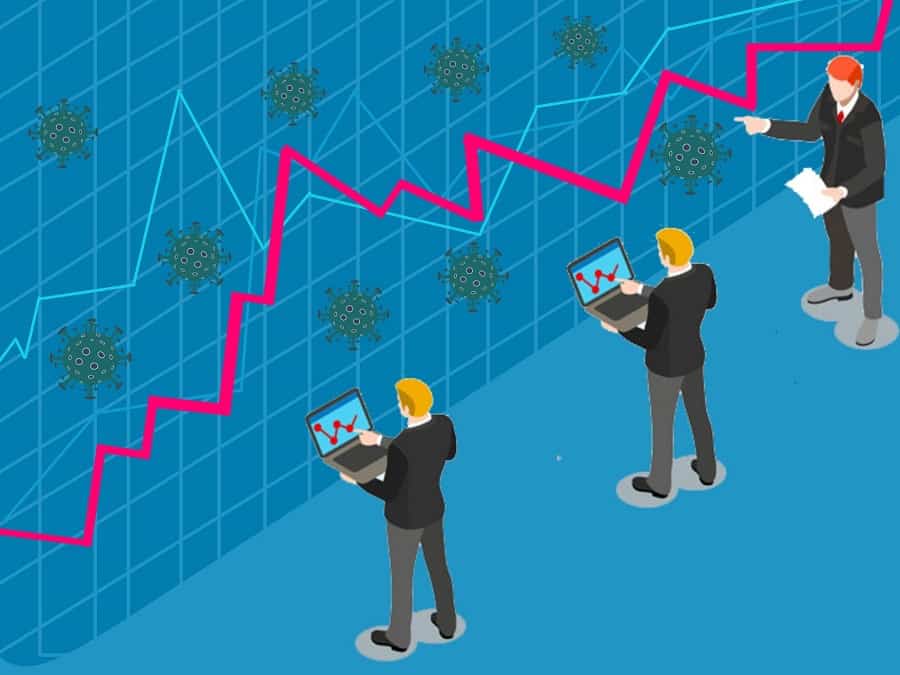
In the early days of the COVID-19 pandemic, when facts were uncertain, decisions were urgent, and stakes were very high, both the public and policymakers turned not to oracles, but to mathematical modelers to ask how many people could be infected and how the pandemic would evolve. The response was a plethora of hypothetical models shared on online platforms and numerous better calibrated scientific models published in online repositories. A few such models were announced to support governments’ decision-making processes in countries like Austria, the UK, and the US.
With this announcement, a heated debate began about the accuracy of model projections and their reliability. In the UK, for instance, the model developed by the MRC Centre for Global Infectious Disease Analysis at Imperial College London projected around 500,000 and 20,000 deaths without and with strict measures, respectively. These different policy scenarios were misinterpreted by the media as a drastic variation in the model assumptions, and hence a lack of reliability. In the US, projections of the model developed by the University of Washington’s Institute for Health Metrics and Evaluation (IHME) changed as new data were fed into the model, sparking further debate about the accuracy thereof.
This discussion about the accuracy and reliability of COVID-19 models led me to rethink model validity and validation. In a previous study, my colleagues and I showed that, based on a vast scientific literature on model validation and practitioners’ views, validity often equates with how good a model represents the reality, which is often measured by how accurately the model replicates the observed data. However, representativeness does not always imply the usefulness of a model. A commentary following that study emphasized the tradeoff between representativeness and the propagation error caused by it, thereby cautioning against an exaggerated focus on extending model boundaries and creating a modeling hubris.
Following these previous studies, in my latest commentary in Humanities and Social Sciences Communications, I briefly reviewed the COVID-19 models used in public policymaking in Austria, the UK, and the US in terms of how they capture the complexity of reality, how they report their validation, and how they communicate their assumptions and uncertainties. I concluded that the three models are undeniably useful for informing the public and policy debate about the extent of the epidemic and the healthcare problem. They serve the purpose of synthesizing the best available knowledge and data, and they provide a testbed for altering our assumptions and creating a variety of “what-if” scenarios. However, they cannot be seen as accurate prediction tools, not only because no model is able to do this, but also because these models lacked thorough formal validation according to their reports in late March. While it may be true that media misinterpretation triggered the debate about accuracy, there are expressions of overconfidence in the reporting of these models, even though the communication of uncertainties and assumptions are not fully clear.
The uncertainty and urgency associated with pandemic decision-making is familiar to many policymaking situations from climate change mitigation to sustainable resource management. Therefore, the lessons learned from the use of COVID models can resonate in other disciplines. Post-crisis research can analyze the usefulness of these models in the discourse and decision making so that we can better prepare for the next outbreak and we can better utilize policy models in any situation. Until then, we should take the prediction claims of any model with caution, focus on the scenario analysis capability of models, and remind ourselves one more time that a model is a representation of reality, not the reality itself, like René Magritte notes that his perfectly curved and brightly polished pipe is not a pipe.
References
Eker S (2020). Validity and usefulness of COVID-19 models. Humanities and Social Sciences Communications 7 (1) [pure.iiasa.ac.at/16614]
Note: This article gives the views of the author, and not the position of the Nexus blog, nor of the International Institute for Applied Systems Analysis.
By Martin Jung, postdoctoral research scholar in the IIASA Ecosystems Services and Management Program.
IIASA postdoc Martin Jung discusses how a newly developed map can help provide adetailed view of important species habitats, contribute to ongoing ecosystem threat assessments, and assist in biodiversity modeling efforts.
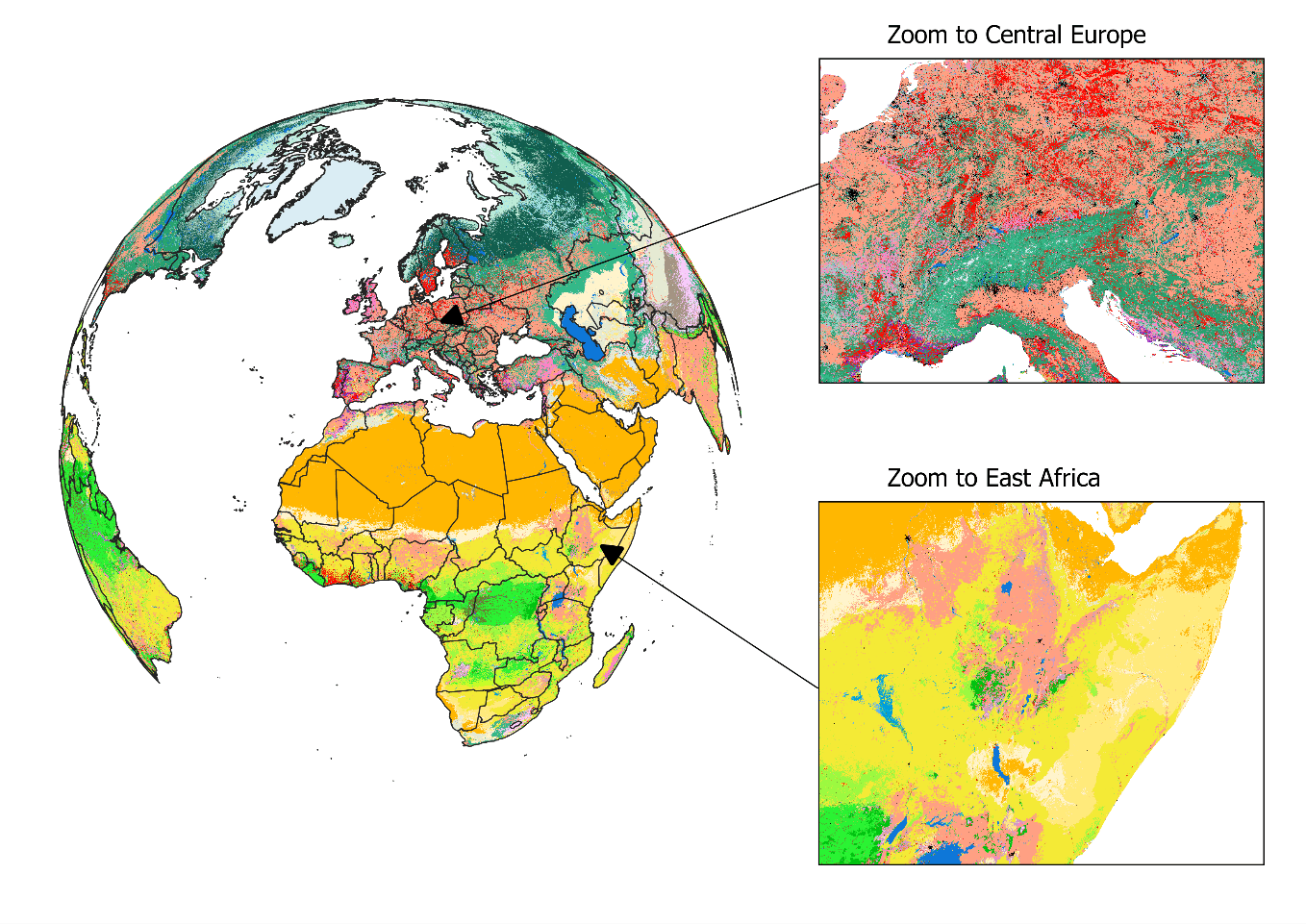
Biodiversity is not evenly distributed across our planet. To determine which areas potentially harbor the greatest number of species, we need to understand how habitats valuable to species are distributed globally. In our new study, published in Nature Scientific Data, we mapped the distribution of habitats globally. The habitats we used are based on the International Union for Conservation of Nature (IUCN) Red List habitat classification scheme, one of the most widely used systems to assign species to habitats and assess their extinction risk. The latest map (2015) is openly available for download here. We also built an online viewer using the Google Earth Engine platform where the map can be visually explored and interacted with by simply clicking on the map to find out which class of habitat has been mapped in a particular location.
Figure 1: View on the habitat map with focus on Europe and Africa. For a global view and description of the current classes mapped, please read Jung et al. 2020 or have a look at the online interactive interface.
The habitat map was created as an intersection of various, best-available layers on land cover, climate, and land use (Figure 1). Specifically, we created a decision tree that determines for each area on the globe the likely presence of one of currently 47 mapped habitats. For example, by combining data on tropical climate zones, mountain regions and forest cover, we were able to estimate the distribution of subtropical/tropical moist mountainous rain forests, one of the most biodiverse ecosystems. The habitat map also considers best available land use data to map human modified or artificial habitats such as rural gardens or urban sites. Notably, and as a first, our map also integrates upcoming new data on the global distribution of plantation forests.
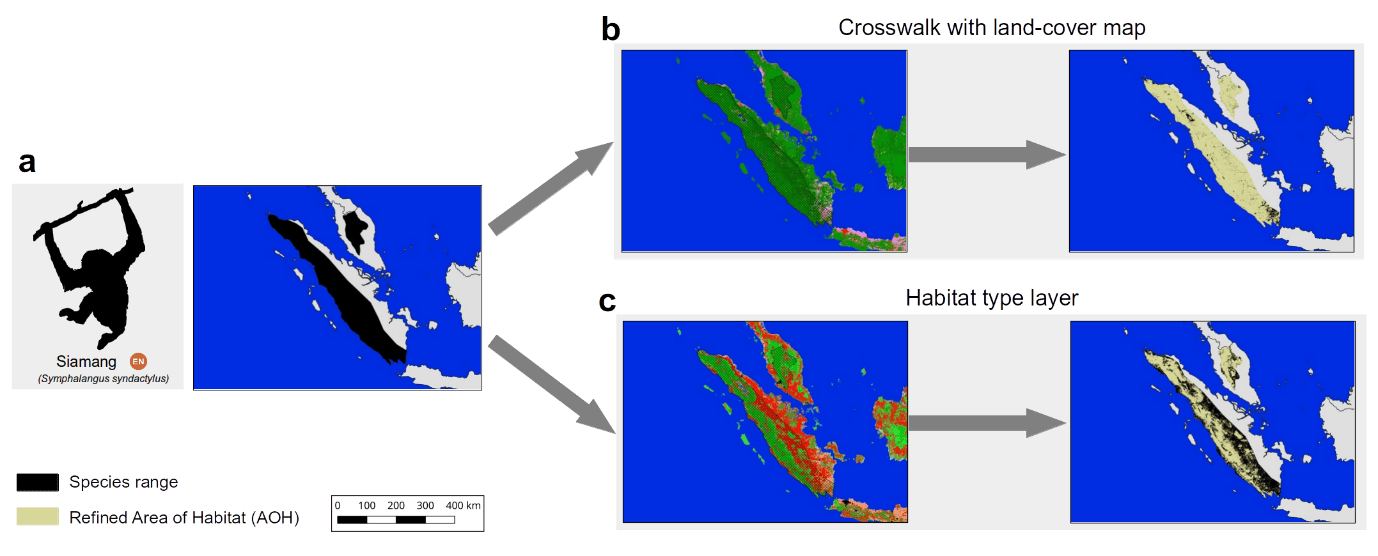
What makes this map so useful for biodiversity assessments? It can provide a detailed view on the remaining coverage of important species habitats, contribute to ongoing ecosystem threat assessments, and assist in global and national biodiversity modeling efforts. Since the thematic legend of the map – in other words the colors, symbols, and styles used in the map – follows the same system as that used by the IUCN for assessing species extinction risk, we can easily refine known distributions of species (Figure 2). Up to now, such refinements were based on crosswalks between land cover products (Figure 2b), but with the additional data integrated into the habitat map, such refinements can be much more precise (Figure 2c). We have for instance conducted such range refinements as part of the Nature Map project, which ultimately helped to identify global priority areas of importance for biodiversity and ecosystem services.
Figure 2: The range of the endangered Siamang (Symphalangus syndactylus) in Indonesia and Malaysia according to the IUCN Red List. Up to now refinements of its range were conducted based on land cover crosswalks (b), while the habitat map allows a more complete refinement (c).
Similar as with other global maps, this new map is certainly not without errors. Even though a validation has proved good accuracy at high resolution for many classes, we stress that – given the global extent and uncertainty – there are likely fine-scale errors that propagate from some of the input data. Some, such as the global distribution of pastures, are currently clearly insufficient, with existing global products being either outdated or not highly resolved enough to be useful. Luckily, with the decision tree being implemented on Google Earth Engine, a new version of the map can be created within just two hours.
In the future, we plan to further update the habitat map and ruleset as improved or newer data becomes available. For instance, the underlying land cover data from the European Copernicus Program is currently only available for 2015, however, new annual versions up to 2018 are already being produced. Incorporating these new data would allow us to create time series of the distribution of habitats. There are also already plans to map currently missing classes such as the IUCN marine habitats – think for example of the distribution of coral reefs or deep-sea volcanoes – as well as improving the mapped wetland classes.
Lastly, if you, dear reader, want to update the ruleset or create your own habitat type map, then this is also possible. All input data, the ruleset and code to fully reproduce the map in Google Earth Engine is publicly available. Currently the map is at version 003, but we have no doubt that the ruleset and map can continue to be improved in the future and form a truly living map.
Reference:
Jung M, Raj Dahal P, Butchart SHM, Donald PF, De Lamo X, Lesiv M, Kapos V,Rondinini C, & Visconti P (2020). A global map of terrestrial habitat types. Nature Scientific Data DOI: 10.1038/s41597-020-00599-8
Note: This article gives the views of the author, and not the position of the Nexus blog, nor of the International Institute for Applied Systems Analysis.






You must be logged in to post a comment.