Feb 12, 2016 | Systems Analysis
By Sergio Rinaldi, IIASA Evolution and Ecology Program and Politecnico di Milano, Italy
Is it possible to predict how love stories develop, progress, and end using mathematical models? I have studied this question over the past 20 years with a group of researchers at IIASA and at the Politecnico di Milano, and as we show in our new book Modeling Love Dynamics (World Scientific, 2016), the answer is yes. The emerging message is that prediction is possible, if we can describe in formulas the way each individual reacts to the love and to the appeal of the partner.
Consider a standard love story, which develops like those described in a classical Hollywood movie such as Titanic. This story can be easily modeled, if one considers reasonably appealing individuals who increase their reaction with the partner’s love – so called secure individuals. Starting from the state of indifference, where the individuals are at their first encounter, their feelings continuously grow and tend toward a positive plateau.
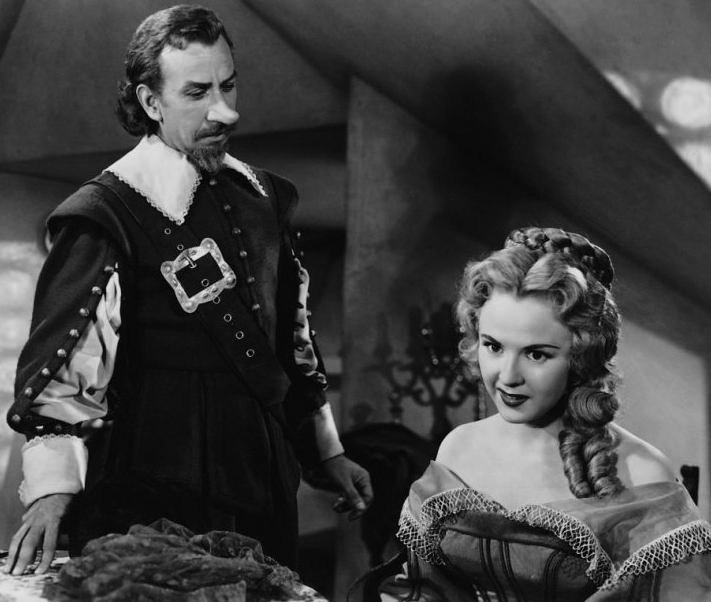
Mala Powers and José Ferrer in Cyrano de Bergerac, 1950. – Public Domain
Love stories become more intriguing when one individual is not particularly appealing, if not repelling, as in the fairy tale “Beauty and The Beast.” Indeed, in these cases, there exists also a second romantic regime, which is negative and can therefore entrain, in the long run, marital dissolution. In order to avoid that trap, people who are not very charming, or believe to be so, do all they can to look more attractive to the partner. At the first date, she wears her nicest dress and he shows up with his best fitting T-shirt. However, after a while, the bluffing can be interrupted, because the couple has entered the safe basin of attraction of the positive regime. Needless to say, the model also supports much more sophisticated behavioral strategies, like that described by Edmond Rostand in his “Cyrano de Bergerac,” the masterpiece of the French love literature.
Not all individuals are secure. Indeed, some people react less and less strongly when the love of the partner overcomes a certain threshold. These individuals, often very keen to flirtation, are incapable of becoming one with their partner. The model shows that couples composed of insecure individuals tend, with almost no exception, toward an unbalanced romantic regime in which the most insecure is only marginally involved and is therefore prone to break up the relationship at the first opportunity. This is why after just 20 minutes of the very long “Gone with the Wind,” when one realizes that Scarlett and Rhett are both insecure, the model can already predict the end of the film, where he quits her with the lapidary “Frankly, my dear, I don’t give a damn.” The same conclusion is expected if only one of the two individuals is insecure. This explains the numerous failures in the romantic life of some individuals, like the beautiful star Liz Taylor, who is described as very insecure in all her biographies, and went, indeed, through eight marriages.
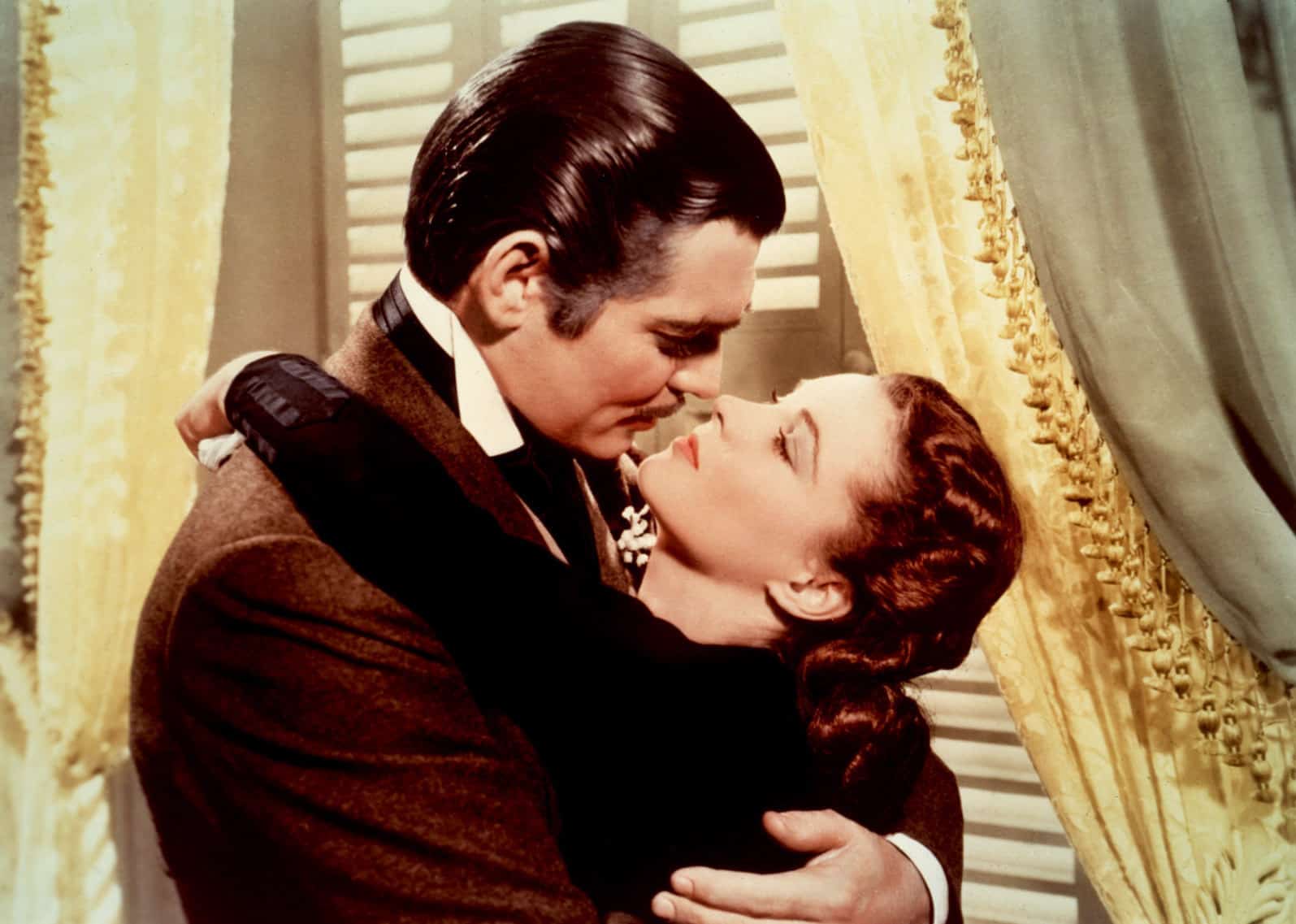
Clark Gable and Vivien Leigh in Gone with the Wind, 1939 – MGM Pictures | Public Domain
Mathematical models can also be used to interpret more complex romantic behaviors. Particularly important is the case of individuals who overestimate the appeal of the partners when they are more in love with them (like parents who have a biased view of the beauty of their own kids). Interestingly, if insecurity is also present, biased couples can have romantic regimes characterized by recurrent ups and downs. In other words, the theory says that bias and insecurity is an explosive mix that triggers turbulence in the life of a couple.
In the second part of the book we focus on the effects of the social environment and to the consequences of extra-emotional compartments. In this context, our analysis of the 20-years long relationship between Laura and the famous Italian poet Francis Petrarch shows that poetic inspiration is an important destabilizing factor, responsible for transforming a quiet relationship into a turbulent one.
Finally, we studied triangular relationships, with emphasis on the effects of conflict and jealousy. In all these cases the dynamics of the feelings can be very wild, up to the point of being chaotic and, hence, unpredictable. When this occurs, the life of the couple becomes unsustainable, because painful periods of crisis can virtually start at any moment: a heavy permanent stress. The model can thus explain why the relationship is often interrupted, sometimes even tragically, as in the famous film by François Truffaut “Jules et Jim”, where Kathe’s suicide is perceived as a real relief.
 More information: Watch a video of Sergio Rinaldi’s talk at the 2015 Systems Analysis Conference.
Reference
Rinaldi S, Della Rossa F, Dercole F, Gragnani A, Landi P, (2015). Modeling Love Dynamics. World Scientific, Singapore [January 2016] http://www.worldscientific.com/worldscibooks/10.1142/9656
Note: This article gives the views of the author, and not the position of the Nexus blog, nor of the International Institute for Applied Systems Analysis.
Feb 10, 2016 | Demography
By Daniela Weber, research scholar in the IIASA World Population Program.
Did you ever notice that you walk faster than your friends, or are you the one lagging behind? Your walking speed doesn’t only reveal how fast you walk; it can predict survival and the “slowing down process” and – according to a recent study – it can tell how old you are in terms of your physical fitness. If you are highly educated, or work in a non-manual job, you could be up to 15 years younger when it comes to your “walking age”—the age you are supposed to be according to your physical performance.

Your chronological age does not necessarily reflect your “walking age,” which can be much younger depending on your lifestyle.
For almost all of us, walking is necessary for our everyday lives. For instance, did you know that walking at about 1.1 meters per second (m/s) means that you can cross the street safely in time before the light changes? The decline in walking speed starts around age 60, previous research has found, and a speed of less than 0.6 m/s is associated with substantial impairments to daily life. In my new study, I investigated physical aging and particularly the walking age of older adults in England.
It’s well documented that higher socioeconomic status is positively associated, for older individuals especially, with better physical functioning, such as faster walking. My results confirmed the effects of education, occupation, and regional wealth on physical aging. For instance, a more highly educated 70 year old walked around 0.1 m/s faster at their normal pace than a less educated person of the same age. I noticed a gap of a similar magnitude comparing manual and non-manual workers, with a higher walking speed in those that worked in non-manual jobs.
Interestingly, living in a wealthier region was also associated with higher walking speed, although the difference is only minor. The positive effect of living in a wealthier area might be down to fitness as a result of daily routine. People living in wealthier, urban areas are more likely to walk to the shops or to catch public transport than their counterparts living in rural areas, where people tend to use their cars for shopping or commuting.
What does a difference of for instance 0.1 m/s mean and why is it important? I highlighted the differences by converting them into years of age. In a nutshell, less educated 70-year-olds walked on average at the same pace as more highly educated individuals who were 6.5-9 years older. At higher ages they had lost 2.5 years of walking age, which has been linked to many general health issues. Overall, the advantage of more education, non-manual work, or living in a wealthier region comprises up to 15 walking age years for men and up to 10 years for women. However, the size of the advantage declines with increasing age.
More information: IIASA Research Project: Reassessing aging from a population perspective
Reference
Weber D (2016) Differences in physical aging measured by walking speed: evidence from the English Longitudinal Study of Ageing. BMC Geriatrics, 16(1):31 [December 2016] doi:10.1186/s12877-016-0201-x
Note: This article gives the views of the author, and not the position of the Nexus blog, nor of the International Institute for Applied Systems Analysis.
Feb 3, 2016 | Systems Analysis
By Andrey Krasovskii, IIASA Ecosystems Services and Management Program
During his workout in the IIASA gym, my colleague Pekka Lauri often runs on a treadmill. He adjusts the velocity of running using the control panel, and it indicates the distance and approximate calories burnt. While Pekka may not be thinking about mathematical models during his workout break, running and other athletic performance can be modeled using some of the same techniques that we use for other questions at IIASA.
Outside of my academic work at IIASA, I am highly interested in sports, and athletics in particular. My wife, Katy Kuntsevich, has won Austrian championships in high jump several times, and my brother, Nikolay, was on his university team as a 400 meter runner.
Visiting my hometown Ekaterinburg, Russia, back in 2014, I got into a dispute with my father, who is a university professor in theoretical mechanics. Namely, my argument was that the sprinters’ acceleration at the finish line of the 100 meter race should be negative. Later on, during the Christmas holidays, I decided to mathematically support my statement.

Left: Prof. Krasovskii with a page from his Lectures in Theoretical Mechanics (Chapter 2, Kinematics, in Russian) featuring Valeriy Borzov on finish. This page was a reason for my study. Top right: Portrait of Isaac Newton.
When athletes run a race, their horizontal velocity can be estimated by modern technologies such as high resolution cameras and lasers. Knowing the horizontal instantaneous velocity, one can calculate acceleration. According to Newton’s law, one can introduce the forces applied to the body center mass of the athlete. Outside a gym treadmill it gets a bit more complicated, with air resistance and headwind or tail-wind. Against these aerodynamic forces the runner applies horizontal force, which drags him forward. In reality it is an “aggregate” of impulsive normal forces generated by feet and the stroke frequency.
The dynamics of an athlete have been described by an ordinary differential equation studied in papers on sprint modeling, first published by physicist J. Keller. This equation has been considered in numerous papers, which have shown that the equation fits the real data for short-distance running (100 and 200 meters). The indicated studies are devoted to the calibration of parameters, to the wind impact analysis, and to the choice of force functions such that the solution satisfies the actual motions, e.g. the running records of Usain Bolt.
The problem of running dynamics reminded me of a type of model that we sometimes use at IIASA, called an optimal control model. Optimal control models are used to calculate the best or most efficient way of doing something, for example, driving from one place to another. If I want to drive from Vienna to Laxenburg, I start my car’s engine at my house (point A). I look at the time, and plan to arrive to IIASA (point B) in 30 minutes. In optimal control terms, the car is a control object, and the driver controls it by pushing the gas/brake pedals and steering the wheel. In the driving process the car meets certain constraints (e.g. the engine power, available roads, and speed limits) and disturbances (e.g. traffic jams, lights, and weather conditions). Obviously, there are many ways of controlling the car in order to reach IIASA in 30 minutes. What if among those admissible controls, I wanted to find an optimal control minimizing car’s energy expenditures during the 30-minute trip from A to B? Here energy is an intensity (cost) of control actions, i.e. fuel (petrol/electricity), or corresponding greenhouse gas emissions. Well, in this case one needs to solve the classical minimum energy control problem. The solution to this problem gives an optimal plan that the car driver (or autopilot) needs to implement. Note, that the corresponding time-optimal control problem consists in finding the fastest driving time to IIASA under given fuel reserve. Optimal control theory (OCT) is an efficient tool for solving such dynamic optimization problems.
My research question was: “Can one control his/her running similar to driving a car?” The answer is: “Yes!”
I applied an optimal control model to Usain Bolt’s performance data at the Beijing Olympic Games in 2008, when he ran the 100 meter sprint in 9.69 seconds. According to the model, under the same conditions he could have distributed his energy optimally and run the distance in 9.56 s. It is worth mentioning that this time is close to his current world record, 9.58 s, achieved at the 2009 World Championships in Berlin. In the paper I also provide modeling results for optimal (energy-efficient) running over 100 m: calculation of the minimum energy and trajectories of acceleration, velocity, and distance from start.
In the conclusion, I argue that applying advanced science in the athletic training programs is far better than doping–better in terms of a healthy body, mind and soul.
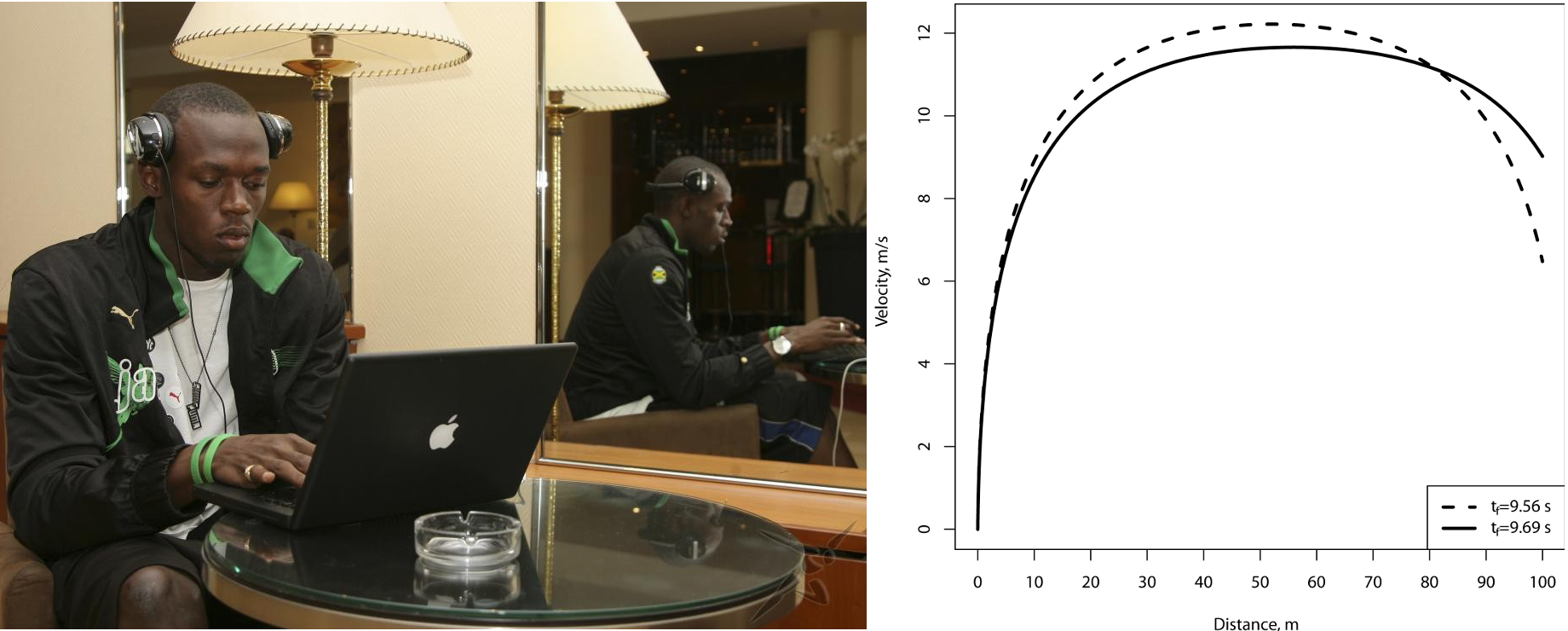
Here is my hypothesis of what Usain Bolt is doing at his laptop. © Weltklasse Zürich – Marcel Giger
Reference:
A. A. Krasovskii, “Application of optimal control to a biomechanics model”, Proceedings of the Steklov Institute of Mathematics, 2015, Vol. 291, pp. 118–126. http://dx.doi.org/10.1134/S0081543815080118
I would like to thank Sergey Aseev, Katherine Leitzell, as well as my colleagues in the IIASA Ecosystem Services and Management Program (ESM) for their interest and valuable discussions.
Note: This article gives the views of the author, and not the position of the Nexus blog, nor of the International Institute for Applied Systems Analysis.
Feb 1, 2016 | Communication, IIASA Network, Science and Art
Known to the world as a metropolis of music the science in Vienna does not receive the recognition and international visibility its excellence deserves. To change this would require not so much more money but a new mindset, agree two prominent players in scientific research in Vienna: Director General and CEO of the International Institute for Applied Systems Analysis (IIASA) Professor Dr. Pavel Kabat and President of the Institute of Science and Technology Austria (IST Austria) Dr. Thomas Henzinger.
How does Vienna and its scientific research community benefit from the presence of the two institutions and vice versa?
Henzinger: Vienna is a hub for scientific research in Europe. There are a number of universities and institutions in Vienna and they all have an important part to play in the research ecosystem. In the end this profits everybody because as the critical mass of research grows the easier it is to hire people. It’s like gravity — big centers attract more of the best researchers from around the world. The Science Ball is a — uniquely Viennese — sign of this. We are now firmly “on the map”, and in Vienna you show that by hosting a ball!
Kabat: I agree. IIASA has a number of fruitful connections with Viennese institutions. For example, IIASA and OäW have worked together to organize a series of public lectures and debates with prominent scientists for the Viennese academic and political community. Our scientific collaborations with researchers in Vienna and Austria as a whole are also very strong, and have resulted in the publication of over 1050 scientific papers since 2008.
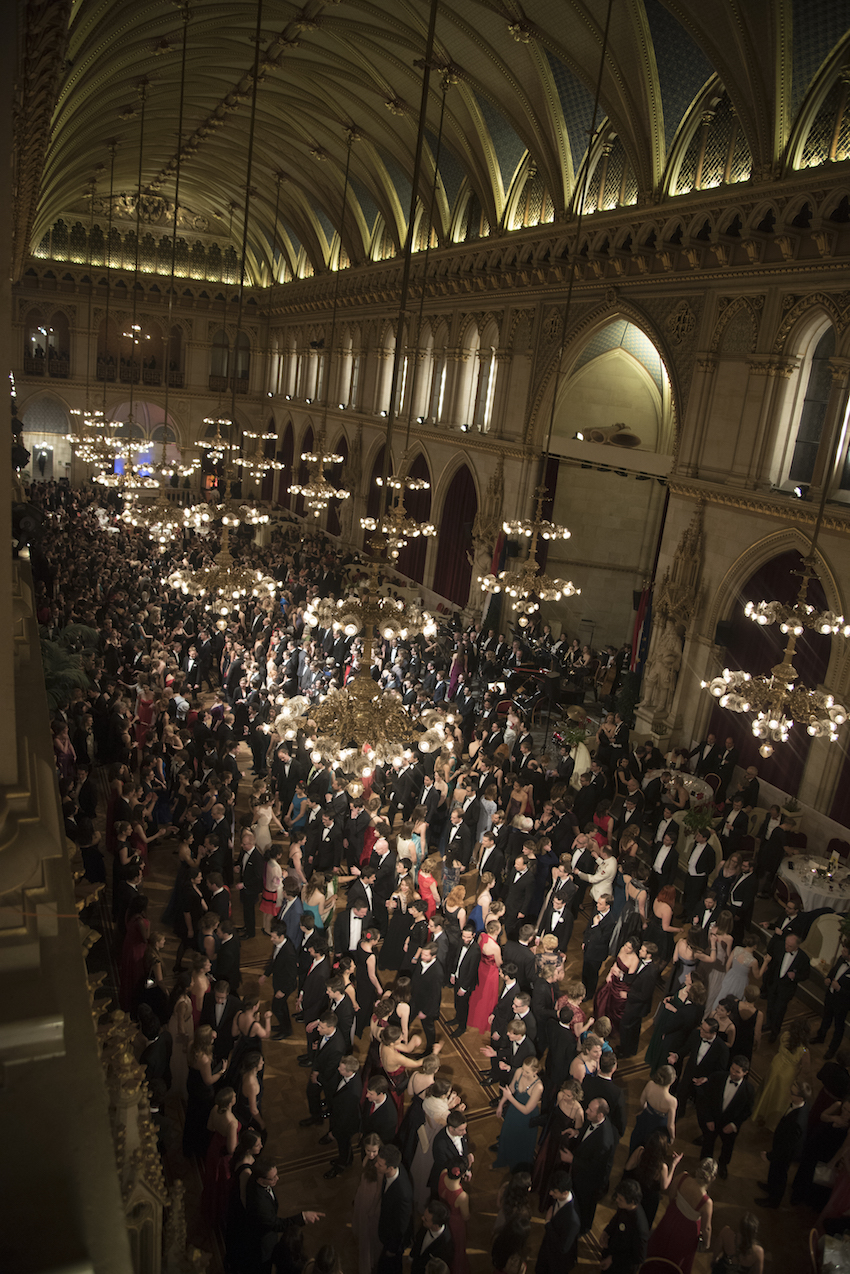
The Science Ball, bringing together Vienna’s diverse scientific community.
Vienna is known as the “City of Music” because of its musical legacy, but why is science not also an important part of the city’s image?
Kabat: This is something close to my heart. IIASA is doing top-level science on transitions towards sustainability; the world is now at a cross-roads and we need to be taking steps in sectors from energy and water all the way to financial systems. Communicating this can be very difficult, so we are using new and unusual collaborations that are made possible by this fantastic Viennese environment. We are working with music, ballet, and the opera. We have partnered up with the Vienna Philharmonic Orchestra, for example, and with dancers from the State Opera to communicate these complex concepts. Science and the arts both have a vital part to play in Vienna’s past and future. I dream of a scientific tour through Vienna featuring collaborations between theatres, museums, and scientific institutions.
Henzinger: There is a lot of history between the golden age of science in Vienna and today, and I think there is a large amount of effort and also a lot of progress in reviving Vienna as a city for science. Science by its very nature is one of the most borderless activities of humanity there is and it can only thrive in a completely open environment. It is no surprise that the glory days of science in Vienna were when it was the hub of a multi-national empire. I think we can only get back to that by becoming much more open-minded and much more international as a country.
The city of Vienna is not legally responsible for science funding, but it is a central research hub and the biggest university city in central Europe. What can the city do to improve its image as a center of scientific excellence?
Kabat: I think a change is needed in the portrayal of Vienna as a whole. There is promotion of music, dance, and the arts. All these are great, but institutions like IST Austria and IIASA should also be used to show that Vienna really is one of the major science hubs of Europe and the world. Emphasizing this would require very little investment but would benefit both Vienna and science in the city. All the components are here, what it needs is a coordinated effort and a vision.
Henzinger: Vienna has an enormous advantage in that is known as a fantastic place to live. The city needs to actively attract not only world-class researchers but all kinds of science-related businesses and organizations. Vienna as a whole must make concerted effort to advertise itself as an attractive location for students, companies, and professionals from all over the world.
Students do not know that if they come to study at Vienna University, for example, they may also be able to benefit from collaborations with scientists working IIASA and IST Austria, who may be able to advise or even co-supervise them. This dynamic and varied environment is a key part of what Vienna can offer, not only the individual institutions. The ball is the perfect step in that direction. It is very clearly an effort that transcends any particular institution.
Kabat: We should continue this talk, not just with the two of us but with all leaders of Viennese scientific institutions, and the mayor, to have a free and frank discussion. Science brings a huge amount to the city of Vienna and it should be recognized. The ball, as you say, is an excellent occasion to bring together Vienna’s vibrant scientific community and celebrate it!
Jan 27, 2016 | Climate Change, Postdoc, Risk and resilience
By Mia Landauer, a Finnish postdoc at IIASA Risk, Policy and Vulnerability Program and Arctic Futures Initiative
When I was a child I did not like cross-country skiing. One reason was that like many other schoolmates in Finland, I had no other option than to ski to school throughout the winter, even when temperatures were below -20 C, and even though my skis were too big because I got them from my sister and so old that they could have broken anytime.
When I decided to write my dissertation in Austria about climate adaptation of winter tourism, I found I still couldn’t get away from skiing. My professor at the University of Natural Resources and Life Sciences (BOKU) asked me to join a research team investigating this topic. “What a great tradition you have in Finland! My friend and colleague from METLA (now Natural Resources Institute) in Finland would love to do research with us but with somebody who knows about cross-country skiing! You are the perfect match!” I guess I was too shy to admit that I was not excited about having cross-country skiing as a case study—but I decided to give it a try.
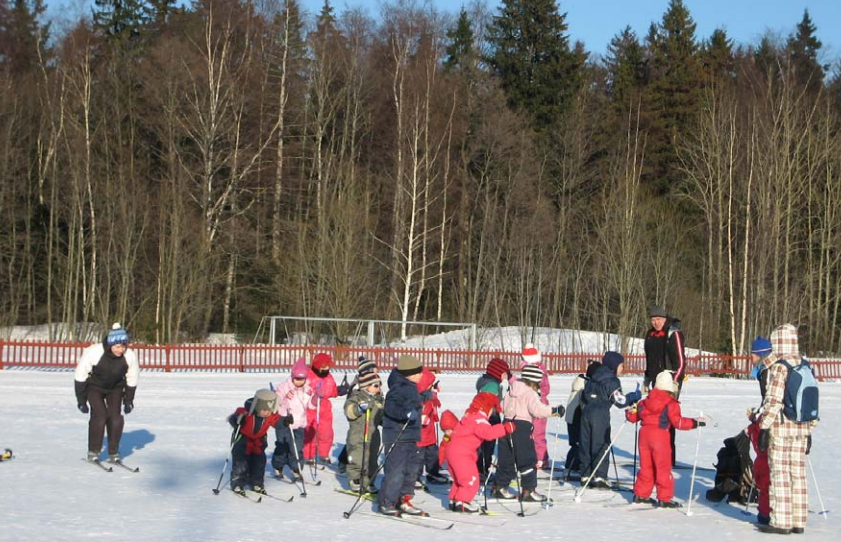
Cross country skiing in Finland is practiced by all age groups (voluntarily or not). Photo Credit: © Mia Landauer
Cross-country skiing is socially and culturally a very important activity in Finland, with considerable health benefits. Forty-two percent of the population practice skiing annually and 98% have the skills. But cross-country skiing, like other snow-based activities, is affected by climate change: even Nordic countries are now seeing lack of snow, shift of seasons, and extreme weather events. The winter 2015/2016 has been no exception. Many Finns are concerned that losing this activity would lead to reduced well-being and loss of cultural tradition. Furthermore, economic impacts on tourism regions brought about by a decrease in skiing would cause problems to local economies heavily dependent on snow-based tourism.
Although vulnerability indicators of some other tourism sectors such as beach tourism exist, nobody had thought about cross-country skiing. So we decided to develop an index, based on climatic observations together with extensive survey data on skiers living in climatically different regions in Finland.
We found that exposure to changes in snow conditions have a considerable effect on regional vulnerability. The most vulnerable skiers are in southernmost parts of Finland, which makes sense. But it is not only the amount of snow and length of winter that matter. We also found that skiers in North and East Finland have the highest capacity to adapt, as indicated by their ability to ski: having the necessary skills and equipment, as well as capacity and willingness to travel to be able to ski.
However, the results also show that if it we could enhance these components of adaptive capacity, also the skiers in the south would have a chance. If there are no adaptation options (no artificial snow tracks, no indoor skiing facilities, or simply no interest to use these, or no money or time to travel to be able to ski), in the short term the Finnish cross-country skiing population will face impacts on health, well-being, and quality of life. In the long term, the skiing culture could be lost. Furthermore, decline in demand would lead to regional economic losses in tourism-dependent local economies.
Attempts are being made to maintain the skiing tradition. Nowadays there are a lot of organized activities where kids are introduced to outdoor activities in a playful and educational environment, and ski school and clubs are being established. They play an important role to create a close and pleasant relationship to nature and increase motivation for skiing. But of course the most important element for skiing is snow.
I have always had a very close relationship to nature. Believe me or not, sometimes I do go skiing although it also brings back the unpleasant memories. Despite them, wintery landscapes and nature experience have motivated me to continue skiing as an adult. The gray and rainy winters make me worried and I simply cannot see myself skiing in a ski tunnel… Albeit “you will never know the true value of a moment until it becomes a memory“, I want snow!
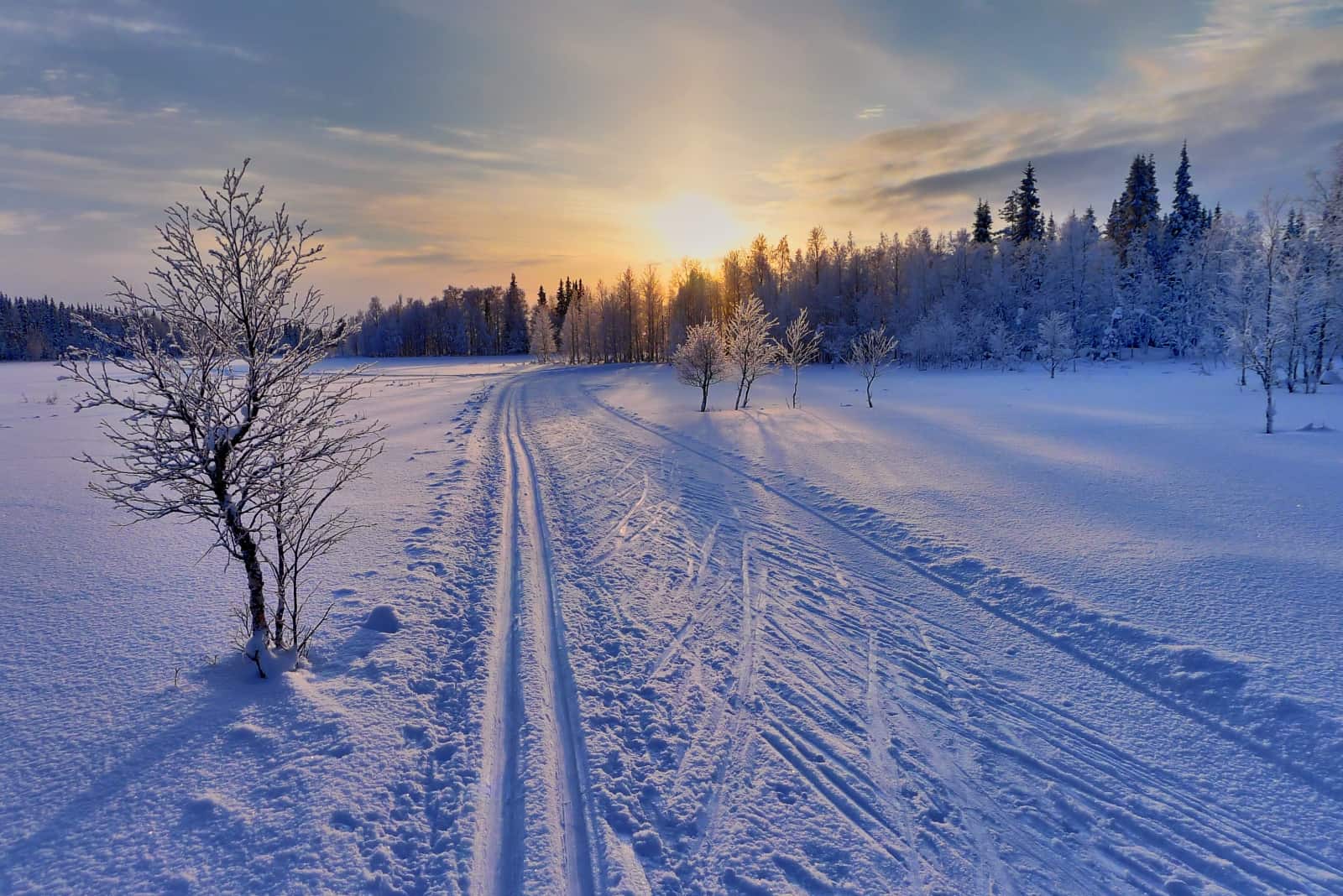
Cross country ski track in Ruka, Finland Photo Credit: © Timo Newton-Syms via Flickr
More information:
Project: “Map Based Assessment of Vulnerability to Climate Change Employing Regional Indicators” (MAVERIC)” http://www.syke.fi/projects/maveric
References
Landauer, M., Sievänen, T., & Neuvonen, M. (2015). Indicators of climate change vulnerability for winter recreation activities: a case of cross-country skiing in Finland, Leisure/Loisir, 39:3-4, 403-440. http://dx.doi.org/10.1080/14927713.2015.1122283
Landauer, M., Haider, W., & Pröbstl, U. (2014). The influence of culture on climate change adaptation strategies: Preferences of cross-country skiers in Austria and Finland. Journal of Travel Research 53(1), pp. 95-109. doi: 10.1177/0047287513481276
Landauer, M., & Sievänen, T. (2011). Suomalaisten maastohiihtäjien sopeutuminen ilmastonmuutokseen. In T. Sievänen & M. Neuvonen (Eds.), Luonnon virkistyskäyttö 2010 (pp. 91–101). Vantaa: Working Papers of the Finnish Forest Research Institute, 212.
Landauer, M., Sievänen, T., & Neuvonen, M. (2009). Adaptation of Finnish cross-country skiers to climate change. Fennia 187 (2), pp. 99–113. http://ojs.tsv.fi/index.php/fennia/article/view/3697
Neuvonen, M., Sievänen, T., Fronzek, S., Lahtinen, I., Veijalainen, N., & Carter, T. R. (2015). Vulnerability of cross-country skiing to climate change in Finland – An interactive mapping tool. Journal of Outdoor Recreation and Tourism, 11, 64–79. doi:10.1016/j.jort.2015.06.010
Neuvonen, M. & Sievänen,T. (2011). Ulkoilutilastot 2010 (Outdoor Recreation Statistics 2010). In: Sievänen, T. & Neuvonen, M. (toim.). Luonnon virkistyskäyttö 2010. Metlan työraportteja / Working Papers of the Finnish Forest Research Institute 212: 133–190
Perch-Nielsen, S. L. (2010). The vulnerability of beach tourism to climate change – An index approach. Climatic Change, 100(3–4), 579–606. doi:10.1007/s10584-009-9692-1
Note: This article gives the views of the author, and not the position of the Nexus blog, nor of the International Institute for Applied Systems Analysis.

You must be logged in to post a comment.