Mar 11, 2016 | Demography
By Luis Castro, researcher in the Sustainability NEXUS Research Cluster of the IIASA World Population Program.
The refugee crisis going on across Europe has brought the importance of migration analysis into sharp focus. Policymakers need to know the answers to many questions that require realistic and timely answers, such as:
- What are the demographic impacts of massive immigration in the short, medium, and long term?
- What are the impacts on a population’s age distribution if the immigrants are migrating as family units, especially if they have a cultural tradition of large numbers of children?
- What are the impacts if the immigrants are mainly males of labor-force age?
- Is there a relationship between education level and the propensity to migrate?
For almost 40 years, IIASA has developed analytical tools and system analysis methods to help answer these questions and others. These methods and tools have been used for UN population projections, as well as by many individual countries around the world, but there is still much research to be done on to help us understand the complex dynamics of migration.
Until the end of the last century, migration modeling was given scant attention. A simple explanation for such lack of interest is perhaps the fact that most social, economic, and demographic research was targeted at the national level. Under such circumstances it was generally assumed that populations were “closed” and international migration was not considered. In addition, demographic studies of sub-national areas used the measure of “net migration”—the number of immigrants minus the number of emigrants—even though this simplifies the situation to the point where key information is lost.
In 1977, just after IIASA had completed its first five years of research activity, the institute announced that a key research theme for the future would be human settlements and services. This focused on developing methods for multiregional demography and included analysis and modeling of age specific migration flows was using data from 17 IIASA national member countries as well as Mexico, which was not yet a member. I dedicated five years at IIASA to developing and testing different migration models investigating patterns of age distributions among groups of migrants, see the graph.
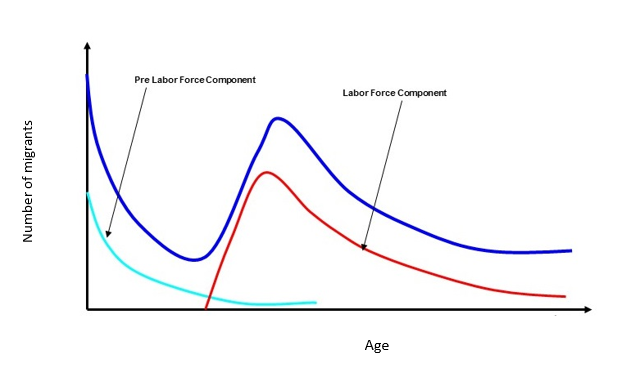
This graph shows how the numbers of migrants of different ages vary. Families migrating, for example, cause a peak in numbers at pre-labor force ages.
Demographic studies often view migration as a collection of independent individual movements. Yet it is widely recognized that many migrations undertaken by individuals whose movements are linked to others. For example, children migrating with their parents, wives with their husbands, or grandparents with their grandchildren.
The aim of my early research at IIASA was to identify some of the effects of family dependency on the migration of men and women, and those of different ages. We developed a model that split migration into independent and dependent flows. This work can explain variations in patterns of migration in societies at different stages of development.
The world has drastically changed since the past 25 years or so, and most nations have become more open and dependent on other countries, more regional alliances have appeared. However, international migration will continue to have the utmost priority for policymakers, not only because of the impacts on the receiving countries but also because of the consequences for the countries of origin.
Note: This article gives the views of the author, and not the position of the Nexus blog, nor of the International Institute for Applied Systems Analysis.
Mar 7, 2016 | Poverty & Equity
Shalini Randeria, a sociologist and social anthropologist focused on legal pluralism and global inequalities, is the Rector of the Institute for Human Sciences (IWM) in Vienna and an IIASA Distinguished Visiting Fellow. On 9 March, she gave a keynote lecture in Vienna entitled, “Precarious livelihoods, disposable lives, and struggles for citizenship rights,” as part of the IIASA-Austrian Academy of Sciences public event, Human Capital, Geopolitical Complexities, and our Sustainable Future.
Q. Why do you say that globalization is full of contradictions?
A. We are living in paradoxical times. The global spread of democracy has gone hand in hand with the erosion of its substance. Decisions once made by national parliaments are now made by supranational institutions, reducing the say of citizens in public decision-making. As people feel disenfranchised, trust in our governments fades. Sometimes going to court seems to be the only way to make governments accountable to citizens. This development not only expands the power of the judiciary but also politicizes it.
What role does globalization play in the inequality between Global North and Global South?
Neo-liberal economic restructuring has increased inequalities between countries but also within each society. We are witness today to an unprecedented concentration of income and wealth, which is not an unforeseen consequence of economic globalization but the result of deliberate public policies. The global South, however, is no longer a geographical category. Greece is an example of European country dependent on international finance institutions in much the same way that once so-called developing countries were.
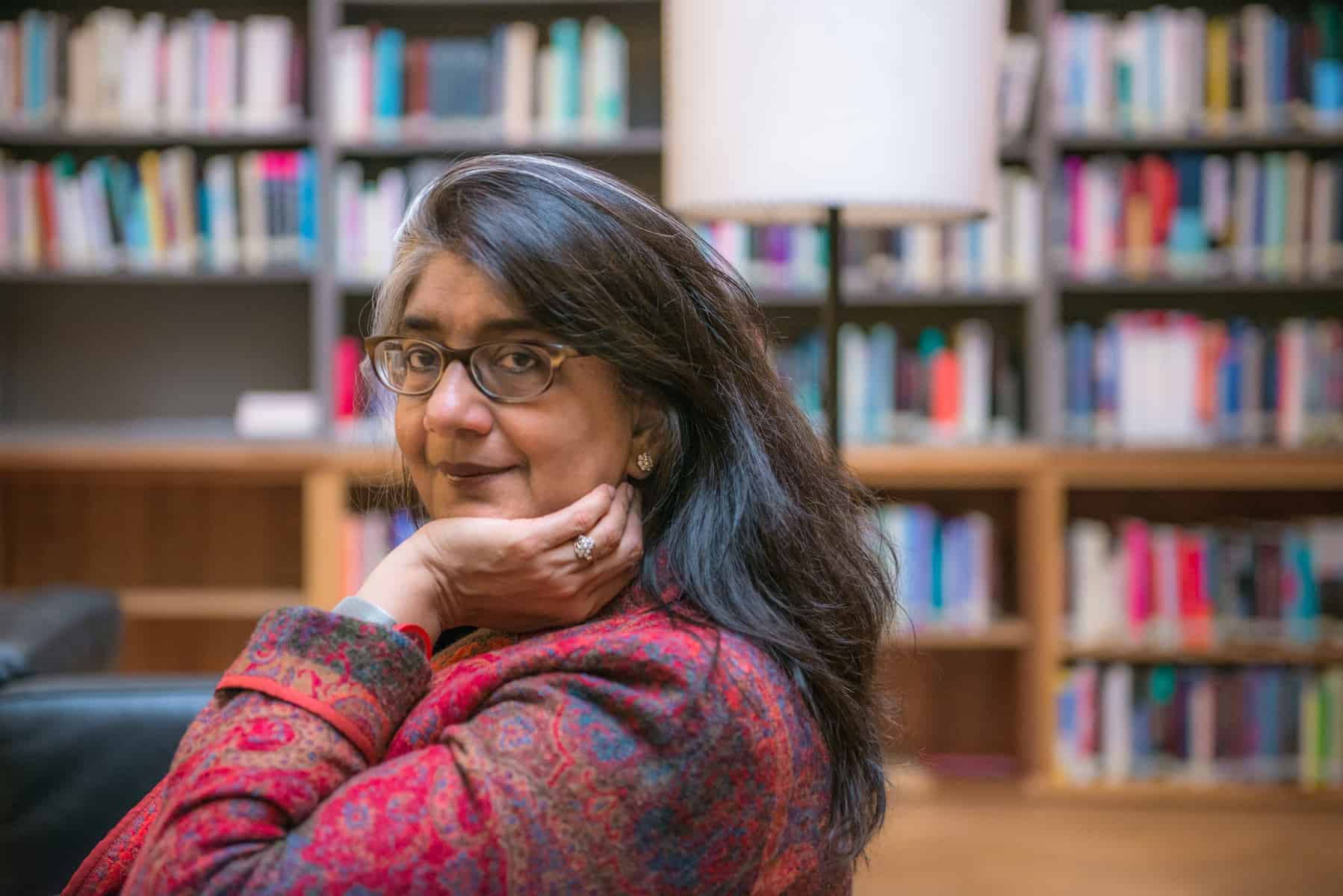
Shalini Randeria © IWM / Dejan Petrovic.
You say that economic and political processes render some lives disposable – what do you mean by that?
Take India for instance: since the country’s independence in 1947, every year some 500,000 people—mostly small farmers, agricultural workers, fishing and forest-dwelling communities —have been forcibly displaced to make room for gigantic infrastructure projects. They have become development refugees in their own country. These people are regarded as ‘dispensable’ by the state in the sense that their livelihoods are destroyed, their lives disrupted, and they are denied access to common property resources. These populations are the human waste that is sacrificed at the altar of an unsustainable model of incessant economic growth.
The Sustainable Development Goals (SDGs), adopted last year, include aims to end poverty, ensure access to employment, energy, water, and reduce inequality, at the same time as preserving the environment. What challenges do you see for achieving these goals?
The SDGs will prove to be an important milestone, if they are implemented the world over. Some of these goals are in conflict with one another. Take the protection of biodiversity, for example, which is often constructed as an antagonistic relationship between society and nature In the new global regime of biodiversity consveration, nature is portrayed as self-regulating, as a pristine, uninhabited wilderness that is threatened due to the wasteful resource use by local populations. Thus access and traditional usufruct rights are curtailed, and indigenous knowledge is devalued and marginalized. The (post)colonial transformation of landscapes into “environment,” “natural resources,” and “biodiversity” has enclosed the commons in most regions of the global South and often commercialized them.
The idea of the Global Commons as spaces and resources that all have access to and also have the responsibility to protect is a useful one in this context. The oceans are but one example of the global commons that include water, forests, or air, which are all being increasingly privatized. The Global Commons also include common resources developed by humans such as virtual data, knowledge, computer software, and medication..
What needs to be done by international institutions to make significant progress in achieving the SDGs?
Eliminating poverty will need an understanding of it that goes beyond a merely economic one. One will need to take into account possibilities of democratic participation, access to public goods and infrastructure, as well as civil rights and a restoration of a plurality of livelihoods. But these institutions also need to be reformed as they have a serious democracy deficit, be it the EU or the Bretton Woods institutions. Unaccountability of international institutions and powerful corporations along with stark asymmetries of power between these and the nation-states characterizes the new architecture of global governance, which need to be remedied urgently if we are to realize global justice.
Note: This article gives the views of the interviewee, and not the position of the Nexus blog, nor of the International Institute for Applied Systems Analysis.
Mar 1, 2016 | Communication, Science and Policy
By IIASA Science Writer and Editor Daisy Brickhill.
“The thing about communicating science today is…people can always watch cat videos instead. And let’s face it, some of those clips are really funny.”
Marshall Shepherd, former president of the American Meteorological Society, smiles at the audience of this science communication seminar, aware of the frustrated sighs going on in the room, and in some cases the blank incredulity—people wouldn’t watch cat videos when they could be paying attention to my science, surely?
We are at the AAAS annual meeting, a vast conference with around 10,000 attendees from all walks of life, from toddlers to retired professors. The science presented here is truly diverse, and covers everything from radically successful new cancer treatments, to advances in artificial intelligence, to the IIASA session on how we can hope to achieve all 17 UN Sustainable Development Goals.
Shepherd is speaking of his long career engaging with the public about his work on weather systems and climate change. “Get out of your ivory tower,” he urges all researchers. There are important issues at stake, and what if no one speaks for the scientific evidence?
However, communicating science effectively is not easy. Understanding something does not mean you are automatically good at explaining it. All through academic training researchers learn how to speak to people in their own field, who talk just like them. That’s important, they might be your next reviewer, after all. But it is only one, narrow form; engaging the public requires a high level of understanding, not just of the topic, but of the audience and communication itself.
“We have left behind the old idea of science communication where brains are empty vessels waiting to be filled,” says the next speaker, Barbara Klein Pope, executive director for communications for the National Academies. “They are a swamp, and we need to explore that swamp to communicate properly.” She describes research which tested the effects of different types of communication on people’s perceptions of social science, in terms of whether they felt it was worth funding, for instance (oh yes, I sense the academic ears pricking up now).
The mind is not an empty vessel waiting to be filled, it’s a swamp to be navigated.
The findings of this work led to a framework of three clear messages. First, use exemplars—a good example can do wonders—yes, your research might be relevant across reams of different cases but general, expansive terms are often vague and a simple example can bring clarity.
Second, the all-important yet surprisingly often neglected question, “Why do we care?” Bear in mind also that it’s not why you care, you’ve made a career out of this science, we know why you care, but why should your audience care.
Finally, use metaphors. Science is often very complex, and pretty much anyone outside your field will need something they can relate to—a familiar concept that they can use to begin to explore the new territory. In case you need more convincing, the use of metaphors was shown to have a significant effect on whether the public felt the work was worth funding.
At the end of that session I was struck by the parallels between this session and another I attended on science-policy interactions with speakers Vladimír Sucha, Daniel Sarewitz, and Peter Gluckman, all working at the forefront of science-policy.
Trust, built on good communication, is vital, the speakers all agreed. Interesting conclusions should not be buried at the end of a report, they should be at the start, just as they would be for the public, and any article or briefing should be kept as short and relevant as possible. Examples and metaphors play a role here too, and a good story with persuasive anecdotes can have much more impact than a dry report.
What not to do, Sucha reminds us, is send an email saying “Here are the links to 200 peer-reviewed papers on this, you’ll find it all there.” After all, policymakers can access cat videos just as easily as the rest of us.
Note: This article gives the views of the author, and not the position of the Nexus blog, nor of the International Institute for Applied Systems Analysis.
Feb 18, 2016 | Demography
In the 21st century the major global divide runs between knowledge societies and those where access to education is hampered or denied, say population experts Reiner Klingholz and Wolfgang Lutz in a new book. In an interview with campus.de they explain what this means.
Education empowers us to look beyond our own horizon and to consciously choose our lifestyle. Better qualified people are more involved in political decision making processes and foster democratization – this is what your book says. Does this mean in reverse that societies with limited education opportunities are, as a rule, less democratic?
Rainer Klingholz: From antiquity to medieval times, the uneducated masses were dominated by despotic elites. Wherever the first seeds of democracy were observed, for example in ancient Greece or Florence during the Renaissance, at least a certain part of the male population could write and read. They were in a better position to see what was going on and they strived for more influence in decision making. The more educated the population became, the more chance there was for democracy. In the modern world, we see a clear statistical association between the education of broad segments of society and a well-functioning democracy, although education is a precondition and not always a guarantee.
There are direct and indirect reasons why education is good for democracy. Education directly fosters the ability to obtain information, express one’s own opinions, engage oneself in discussions and look for compromise, all prerequisites for a lively democracy. Education works indirectly through economic development as it fosters prosperity, and such societies are in a better position to afford the ‘luxury’ of democracy. Even autocratically governed countries, such as Singapore and China, which have invested massively in education and achieved rapid economic growth, can also be seen as moving in the direction of democracy in a long term.

Singapore (home of the aquarium pictured here) and other Asian countries have invested heavily in education, with impressive results. © Goinyk Volodymyr | Dreamstime.com
You say that in a context of global competition countries with low educational standards have lower chances to succeed. Could these countries get out of misery by their own strength or does this problem require a global solution?
Wolfgang Lutz: Looking back in history, we see that many countries have made it without outside assistance. In our book we describe the example of Finland, which was one of the poorest regions of Europe before 1900 and later due to massive educational efforts became not only a winner of PISA test but also one of the most innovative industrial countries. Or, let’s look at Mauritius, which as recently as the 1960s presented a textbook example of a country trapped in the vicious cycle of poverty, population growth, and destruction of the environment. Today, thanks to an early boost in education that was followed by fertility decline and economic growth, it is the most successful country in Africa. Similarly, the rise of the “Asian Tigers” has been induced by massive investment of their own modest means into basic education of the broad layers of population.
In many other countries, mostly in Africa and in South and West Asia, this did not happen. As a consequence, there is still widespread poverty and birth rates have remained high, causing continued rapid population growth and difficulties in finding solutions for existing problems. Under these circumstances, it is not surprising that dissatisfaction results in conflicts which in turn trigger streams of refugees. There are of cause many other reasons for this but lack of education is a root cause.
The most important factor behind decreasing fertility rates is female education. If women complete at least secondary school, they have substantially fewer children, they and their offspring are much healthier, and they become more independent from their husbands, as they are better informed and can obtain their own income. Education is the best and most effective development aid. In order to make this happen, the least developed countries need urgent help from outside. The world cannot wait decades for these countries to later possibly make it on their own. By that time, their population may have multiplied by a factor of 3-5, resulting in higher poverty and possible conflicts. There is good reason why there has been compulsory education and a right to education for all children until the age of 16 for a long time in all developed countries. This must apply equally to all children of the world.
Just a small portion of total development aid expenditures goes into education. Have we still not recognized the problem?
Reiner Klingholz: We have, on paper. The new Sustainable Development Goals (SDGs) of the United Nations postulate exactly this. The problem is that these ambitious education goals are not being implemented. Only 2 to 4 percent of global development aid goes into basic education; this makes it impossible for all children to complete primary school and even less secondary school. Most of the development money goes into big infrastructure projects that satisfy local potentates and promote corruption and exports from the donor countries. Building of a rural school, or education of teachers, in Mali or Pakistan are not attractive in that sense. Since educational efforts only become noticeable in 10-20 years, it is much more attractive for a current president to build a new highway. Despite or perhaps because of this, we point out that investment in basic education is the most important investment for enhancing the ability of people and countries to help themselves and it therefore should become an absolute priority in international development.
In some Arab or African countries there is a youth bulge without adequate occupation or place in the society. What are the long-term consequences of this?
Wolfgang Lutz: The main problem of these countries is that the population grows faster than opportunities are being created, especially job opportunities. Many young people do not see prospects for their lives and at the same time they see through TV or internet that elsewhere people are much better off. Under such conditions, young men in particular have a tendency to become radicalized, or fall victim to religious zealots, who tell that people of different religions are the enemies. This mixture leads to a clash between education cultures that we describe in the book.
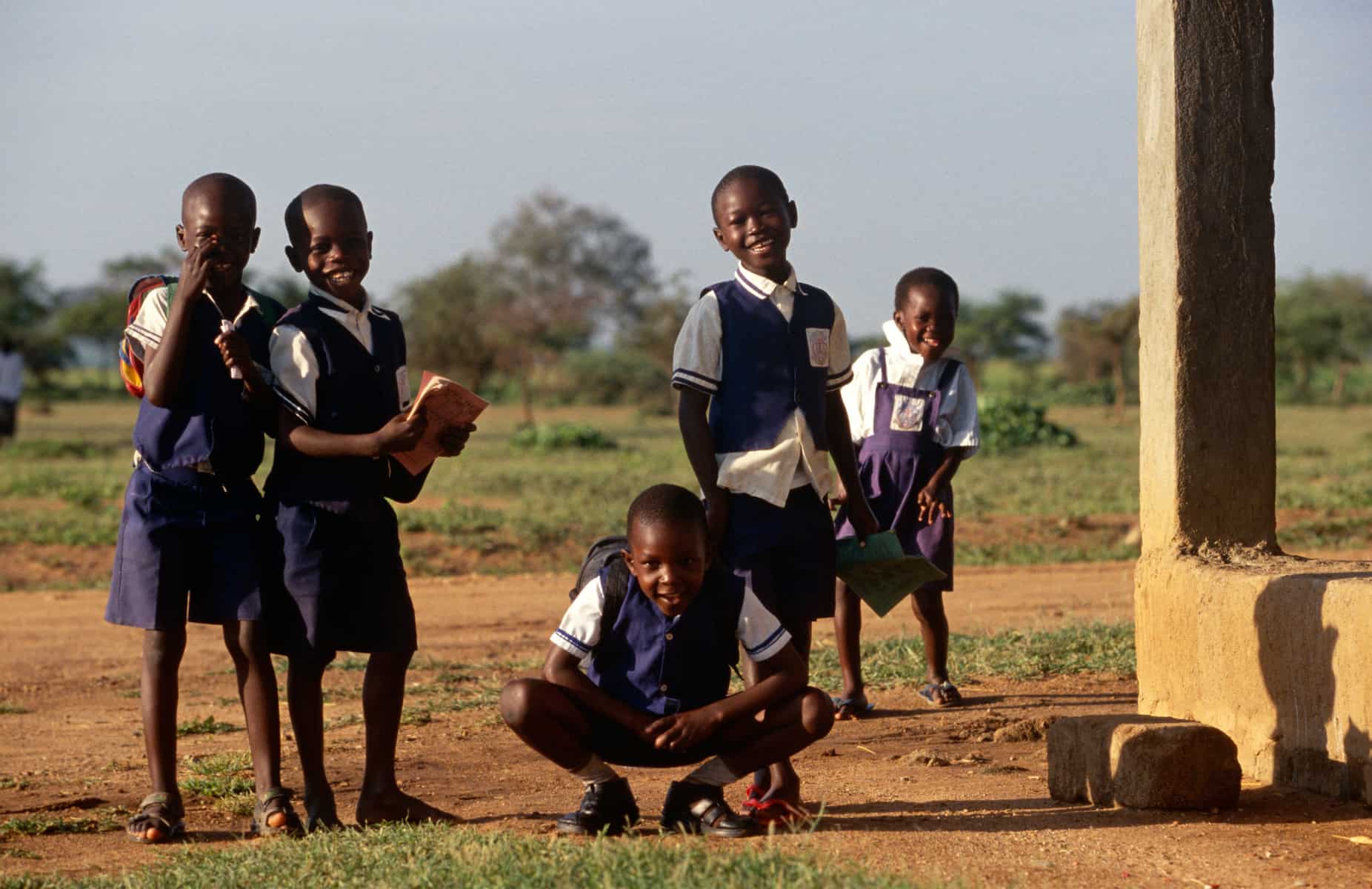
Students outside a school in Rwanda © Alangignoux | Dreamstime.com
Who or what impedes education in countries like Pakistan, Egypt, or in Western Africa?
Rainer Klingholz: Until the middle of 20th century, most of those countries were pawns in the hands of colonial powers that did not invest in broad education. They were afraid of a population empowered through mass education. In the majority of these countries with independence, authoritarian governments came to power who pursued the same goal: they wanted to stay in power surrounded by small educated elites and had no intention of empowering their citizens through education. Fortunately, in many of the countries the situation has improved in recent years and younger generations are now better educated than the older ones. But there is a real threat from fundamentalist religious or terroristic groups, such as IS or Boko Haram, that actively fight against modern education. They want to stop the teaching of natural sciences and instead have boys memorize the holy scriptures and exclude the girls from education altogether
What does Martin Luther have to do with your book?
Wolfgang Lutz: Martin Luther was the first person in history who actively and successfully fought for the basic education of all, including girls and the poorest farmers. He wanted every individual to find his/her own way to salvation through being able to read the Bible. To achieve this, Luther had to translate the Bible into a language that people understood. But most of all, he had to do something to enable all people to read themselves. This focus on universal literacy was new in world history and went further than e.g. the rather elitist humanists had gone.
Interestingly, we see today that the protestant countries that first implemented those educational reforms in the course of the next decades and centuries became more economically successful as a consequence. The rise of the Netherlands and Great Britain, the industrial revolution, and the later success of the United States, the improvement of living conditions and declining death rates—all this had as a necessary precondition the education of broad segments of the population that ultimately goes back to the Reformation. Luther himself did not have long-term social and economic consequences in mind. Coming from a medieval culture he personally would have been probably unsettled by the following developments towards modernity.
In your book “Who survives?” you describe different scenarios of the future of humanity to the end of the 21st century depending on investments in education in the near future. Can we only survive current and future crises if we indeed prioritize education?
Rainer Klingholz: At the beginning of the 21st century, humanity faces the biggest challenges in its history. It has to abolish poverty, stop population growth, combat climate change, and sustain peace in a world which at the moment may seem to be falling apart. These problems require the best possible brain power and the empowerment through education of everybody. The alternatives to education are high population growth in the poor countries where uneducated women have much higher birth rates together with many other development problems, which likely result in chaos and possibly conflict.
Wolfgang Lutz: The problem is that education needs time to show its positive effects. We have to wait until children come out of school and become active adults. Education is hence not a quick solution to any of the urgent problems that fill today’s newspapers. But in a long run, there are no alternatives to universal education.
Note: This article gives the views of the interviewee, and not the position of the Nexus blog, nor of the International Institute for Applied Systems Analysis.
Feb 15, 2016 | Climate Change, Risk and resilience
By Thomas Schinko, IIASA Risk, Policy and Vulnerability Program
Climate change is projected to disproportionately affect people in developing countries, through extreme weather events and slow onset events such as rising sea levels. Because the countries most affected by climate change are also those who contributed the least to the problem and with the least capacities to cope, one of the major issues in recent climate negotiations has been how to support those nations’ efforts to adapt and to address climate impacts beyond adaptation.
To address this problem, in 2013 the United Nations Framework Convention on Climate Change (UNFCCC) established the Warsaw International Mechanism (WIM) for Loss and Damage Associated with Climate Change Impacts (WIM).
Yet at the Paris climate talks in December, the future of the WIM was in limbo. The Global South argued for loss and damage to be a key part of an eventual agreement, while the Global North argued for including it under the adaptation agenda. In the end, the Paris agreement quite prominently featured loss and damage. However the Global North’s fears of signing up to a mechanism that makes them liable for unlimited damage claims in the future have been addressed by adding a specific paragraph to the agreement stating, “the agreement does not involve or provide a basis for any liability or compensation.”
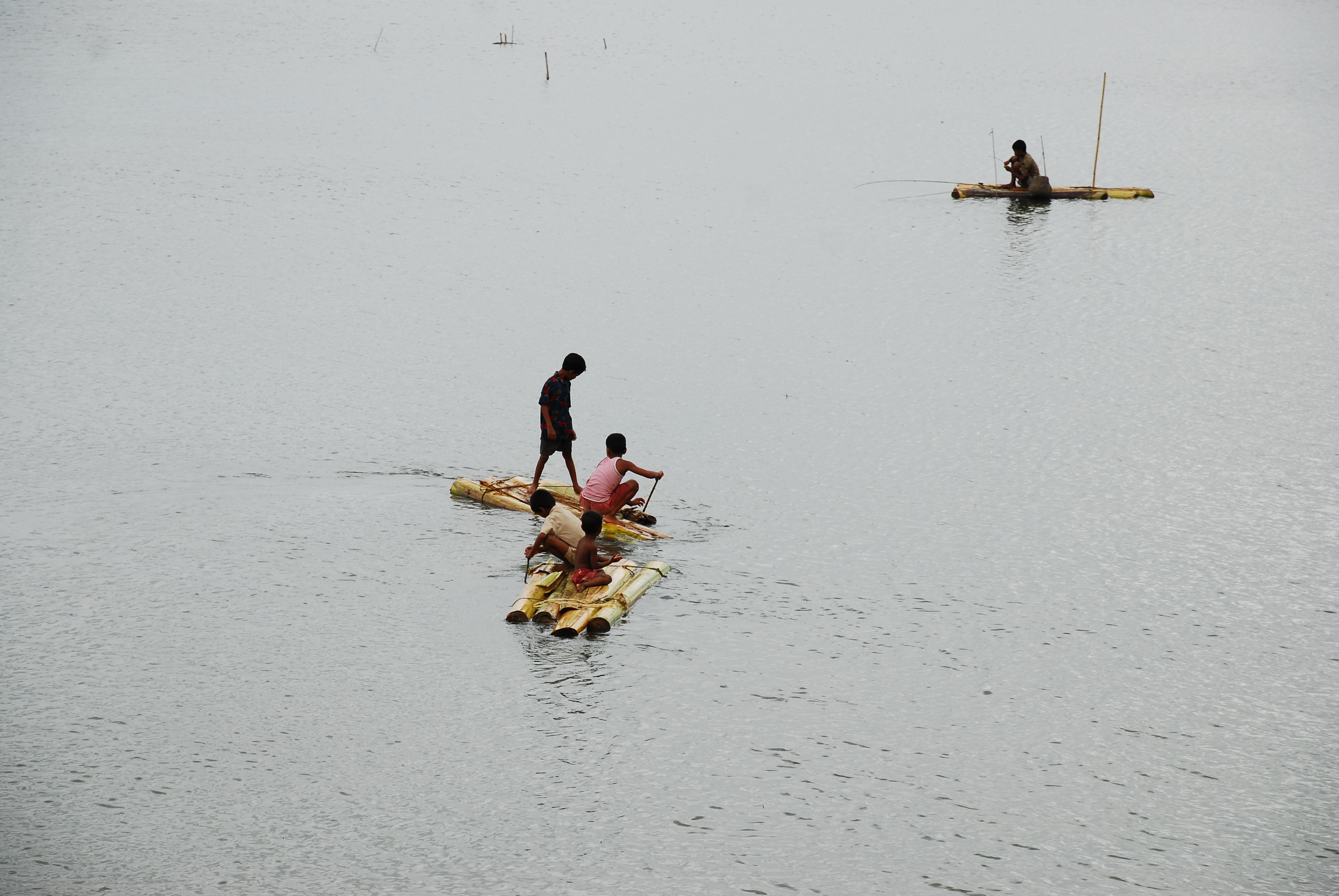
A flood in Bangladesh in 2009. Flooding is project to increase with climate change, yet arguments remain about attributing specific events to the influence of climate change. Photo Credit: Amir Jina via Flickr
Building on this reconfirmed support for the mechanism, the second meeting of the Executive Committee of the WIM was held 2–5 February 2016, in Bonn, Germany. The main purpose of the meeting was to give an update on the delivery of specific activities and to consider relevant requests arising from COP21. The Paris agreement requests the establishment of (1) a clearinghouse for risk transfer to facilitate the implementation of comprehensive risk management strategies and (2) a task force to address displacement issues. On the first issue, discussions have focused on the need to move beyond focusing solely on risk transfer and the link between current disaster risk management practice and climate adaptation as there are important overlaps.
As an observer, I could feel the presence of team spirit among the committee members, all honestly committed to help the most vulnerable people. Yet one issue remained hotly debated: the degree to which anthropogenic climate change can be blamed for natural disasters and extreme weather events. I saw a strong divide between committee members from the Global North and South and between those with a strong background in disaster risk management in contrast to those coming from a climate change background. Nevertheless, even in that regard I see a good chance for a joint vision to emerge, if we can distinguish two levels of the loss and damage discourse: the practical implementation on the ground vs. the political dimension.
On the practical implementation side, a pragmatic compromise became palpable: Building on decades of experience in disaster risk management related to weather extremes and the climate variability, it was identified as an entry point to deal with current and future climate risks – whether they are triggered or intensified by climate change or not. The political level, which circles around climate finance and the question of who is going to pay for losses and damages is quite another matter. Here the anthropogenic element is existentially important, as it builds the foundation for international support under the UNFCCC. If reference to anthropogenic climate change is left out of the loss and damage discourse, the UNFCCC might lose its mandate for support, as disaster risk management falls under national responsibility. Once this door closes it could remain shut, though another one might open (e.g. via civil law).
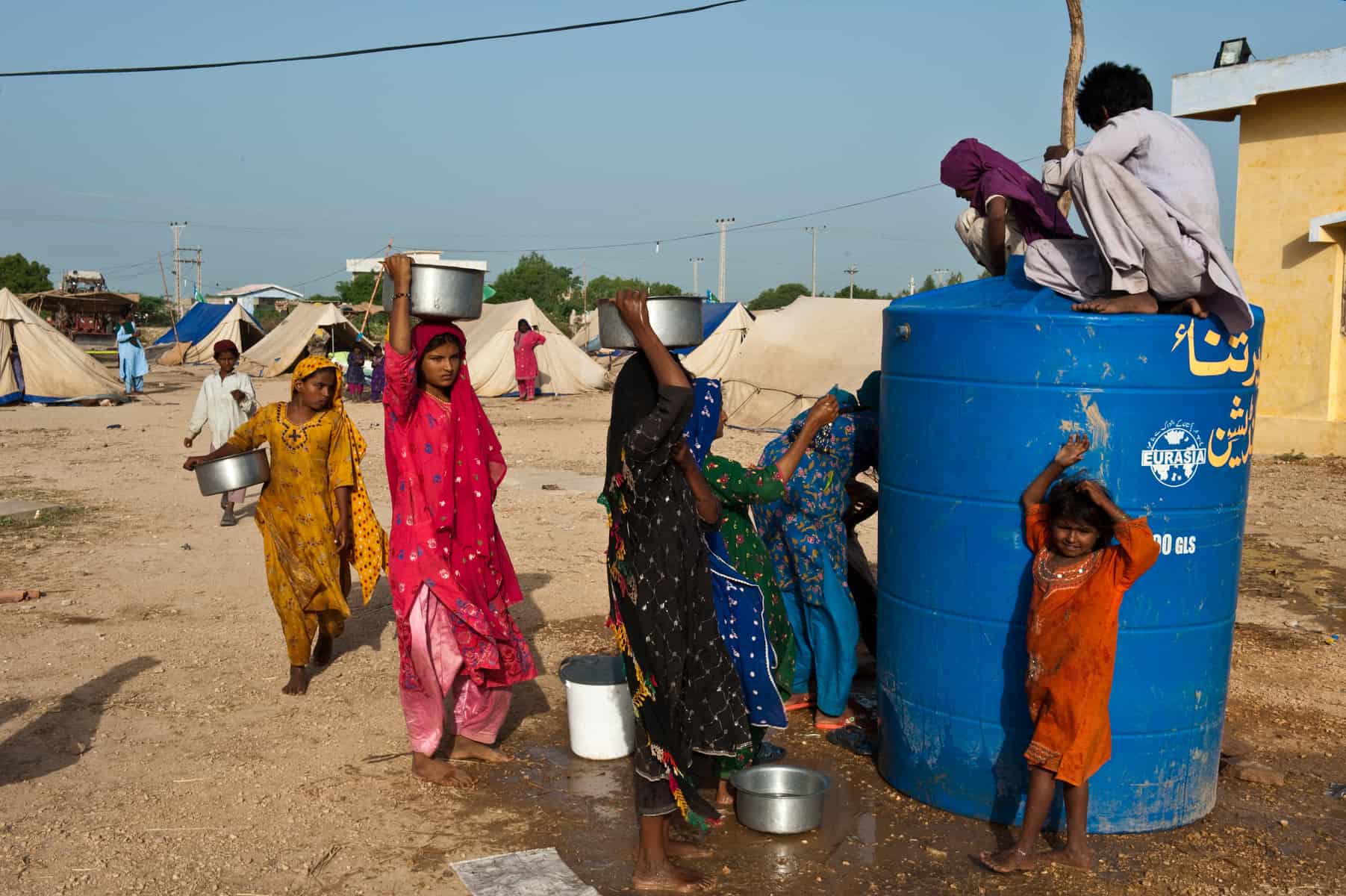
Women in Thata, Pakistan line up for water following 2010 floods. Photo Credit: Asian Development Bank via Flickr
To overcome the political barriers and to build upon the convergence with respect to the short-term practical implementation, we suggest to foster an iterative and comprehensive risk management approach, linking risk prevention, risk reduction, risk retention, risk transfer, as well as ex-post relief and reconstruction to effectively tackle different layers of climate risks.
However, it is important not to lose track of climate change as a risk driver, by consequently screening new scientific and empirical insights. This is crucial, as future risks might substantially increase due to climate change, requiring an iterative adaptation of current practices and support by the international community.
To support such an approach, rigorous scientific input, bringing together researchers from various disciplines, practitioners, NGOs, and policy makers is crucial. Together with international partner institutions, in November 2015 we initiated a scientific hub on loss and damage to provide such input. The envisaged clearinghouse for risk transfer and the task force for climate-related displacement could become key recipients for information generated by our network, packaged with further information and distributed to make it actionable; particularly addressing the needs of the most vulnerable developing countries.
Note: This article gives the views of the author, and not the position of the Nexus blog, nor of the International Institute for Applied Systems Analysis.

You must be logged in to post a comment.