By Bruce Beck, Imperial College London and Michael Thompson, IIASA Risk, Policy and Vulnerability (RPV) Program.
What do Arsenal’s Emirates Stadium in London, the now glorious heritage of Islington’s housing stock, and the cable-car system in Kathmandu for getting milk supplies to that city, all have in common?
They are (or were) all transformative in their own way. All are commendable outcomes from the process of city governance that we argue will be essential for Coping with Change, the subject of our working paper for the Foresight Future of Cities project. Each is a primary case study in the analysis of our paper. We call this kind of governance ‘clumsiness’. It is something that does not evoke any sense of the familiar attributes of suaveness, elegance, and consensuality implied and valued in most other kinds of governance. So what, then, makes this thing with such an awkward, provocative name so relevant to the future of cities?
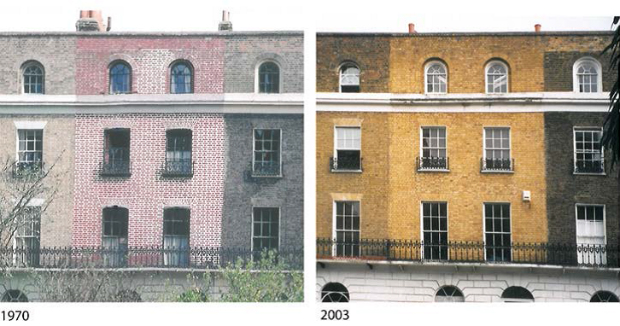
Before and after: Islington’s clumsy and resilient resurgence.
Imagine the city being buffeted about by all manner of social, economic, and natural disturbances over time. There will be times for taking risks with the city’s affairs, and times for avoiding them, or managing them, even just absorbing them – 4 mutually exclusive ways of apprehending how the world works, as it were, and 4 accompanying styles of coping.
In the financial industry, this risk typology has been referred to as the 4 seasons of risk. These are strategically and qualitatively different macroscopic regimes of system behaviour; coping with change between one and another of them is every bit as strategically significant. Conventionally, we recognise only 2 of these regimes: those giving rise to boom and bust in the economy. They reflect just 2 of the 4 ways of understanding the world and acting within it. The nub of the distinctive advantage of clumsiness over other forms of governance for coping with change and transformation is the richness of its (fourfold) diversity of perspective, from which may derive resilience and adaptability in the city’s response to any disturbance – big or small, economic, social, or natural.
Clumsiness is most assuredly deeply participatory. Its process is assiduously supportive of robust, noisy, disputatious debate: witness the gyrations in the Arsenal, Islington, and (especially so) Kathmandu case studies. This is exactly as one should expect of any meaningful engagement among the city’s stakeholders: the public-sector agencies, community activists, private-sector businesses, and so on, all with their own vested interests. The 4 ways of seeing the world are mutually opposed; each is sustained in its opposition to the others, as will be the shaping of their aspirations for the future. Each needs the challenges from the others, not least to avoid the ‘group-think’ in governance that is of such considerable concern to government in managing financial risk.
At the peak of deliberative quality in governance, all 4 outlooks are granted access and responsiveness in the debate, in the process of clumsiness, in other words, in coming to a decision or policy — with ever higher social consent. And in the clumsiest of outcomes, each opposing group gets more of what it wants, and less of what it does not want, at least for a while, until everything about the city’s affairs is revisited once again, as the various seasons of risk come around, each holding sway in turn. As we say in our working paper, clumsiness is why village communities in the Himalayas and Swiss Alps have remained viable over the centuries, without destroying either themselves (‘man’) or their environments (‘nature’) – sustainability par excellence, in other words.
So now we must ask: can cities be viable and sustainable in the same way as these mountain villages? In particular, how can the city’s built environment – the infrastructure that mediates between nature and man, the natural and human environments – be made resilient and adaptable, especially in an ecological sense? Thus might we possess this much prized attribute of systems behaviour in each of the natural, built, and human environments, and in a mutually reinforcing manner. What role might clumsiness have in all of this?
In closing our working paper, where we “connect the systemic dots” of our entire argument, we touch upon a computational foresight study in seeking a smarter urban metabolism for London. The fourfold typology of clumsiness is employed to define future target aspirations for the city (quantitatively expressed, under gross uncertainty). These should be the distant outcomes of the fourfold narratives of how the world is believed to work and what it is that each attaching vested interest much wants – and decidedly does not want. An inverse sensitivity analysis (redolent of a computational backcasting) identifies what is key (and what redundant) to the ‘reachability’ (or not) of each of the 4 sets of aspirations for the distant future. Imagine then the urine-separating toilet (UST) as the clumsy solution to a smarter metabolism for London – a smarter way, that is, of the city’s processing of the resource flows of water, energy, carbon, nitrogen, and phosphorus passing through its social-economic life. Rather more grandly put, imagine instead the UST as a “privileged, non-foreclosing policy-technology innovation” for today!
Well now … if clumsiness is such a jolly good thing, what else might it do for us and our cities? We submit it promises the prospect of greater resilience and adaptability in the governance of innovation ecosystems, extending thus the lines of evidence recounted for re-invigoration of the industrial economy of NE Ohio in Katz & Bradley’s recent (2013) book Metropolitan Revolution. ‘Resilience’ and ‘ecosystem’ are (for now) ubiquitous in our everyday language. But no-one, as far as we are aware, has thought of applying the immensely rich notion of ecological resilience to orchestrating the creative and clumsy affairs of an innovation ecosystem. We are currently examining this.
What does your research say about population and climate? In our recent review article published in the journal Population Studies, we give a summary of much of the work that has been carried out over the past few years both at IIASA and at the Wittgenstein Centre for Demography and Global Human Capital (IIASA, VID/ÖAW; WU) on the contribution of changes in population size and structures to greenhouse gas emissions, as well as societies’ capacity to adapt to climate change. Similar to Mia Landauer in last week’s blog entry, we emphasize the importance of addressing challenges to mitigation and adaptation jointly.
What’s new or unexpected in this study? The main novelty behind our approach is the explicit inclusion of the full population detail by age, sex, and educational attainment in assessments of societies’ future adaptive and mitigation potential. This is exemplified in the context of IPCC-related climate change modelling which until recently has included only very limited information on the future of population. The new Shared Socioeconomic Pathways (SSPs), which were developed with a huge contribution by IIASA, are an important step to overcoming this situation and to make models of both future greenhouse gas emissions, as well as vulnerability and adaptive capacity with respect to climate change far more realistic.
Why is it important to consider the composition of population in regards to future climate change issues? When thinking about the challenges of the future, it is important also to think about the capabilities that future societies will have to face them. I don’t mean that we should simply lean back and wait for science-fictional future technologies to solve all the problems of humanity, but a look at the changing future composition of populations around the world gives reason for optimism that future societies will be better at preparing, coping, and dealing with the consequences of yet unavoidable climate change than we are today.
What are the links between education and climate change? Particularly in the developing world, education leads to reduced poverty. But economic growth and the resulting greater affluence, and consumption, also increases global CO2 emissions. So on a first look, education appears to worsen climate change. This has made some environmental activists skeptical about the value of education in the context of mitigation. But to avoid playing poverty eradication and well-being against climate change mitigation, it is necessary to look at behavioral differences at given levels of income. In fact, better education has been shown to be related to more eco-friendly consumption behavior, especially when it comes to home energy use and transportation, two of the main drivers of climate change. In addition to that, education has also been a major driver of technological advancements in the transition to cleaner energy sources.
How do the new SSPs bring demography into the study of climate change?
Population growth is undoubtedly one of the main drivers of greenhouse gas emissions and thus climate change. What’s far less acknowledged is the importance of differential climate impact depending on demographic characteristics. Groundbreaking work by researchers from IIASA and the National Center for Atmospheric Research (NCAR) featured in the article has shown that people have different footprints when they are young than when they are old and that household consumption differs between rural and urban dwellers. Providing different scenarios for the future composition of populations by age, sex, and educational attainment, the new SSPs for the first time allow researchers from different fields to study the dynamics between population and climate change within a common reference frame.
References Lutz W, Striessnig E (2015) Demographic aspects of climate change mitigation and adaptation. Population Studies: A Journal of Demography, 69(S1):S69-S76 (April 2015). doi: 10.1080/00324728.2014.969929
O’Neill, Brian C., Michael Dalton, Regina Fuchs, Leiwen Jiang, Shonali Pachauri, and Katarina Zigova. “Global Demographic Trends and Future Carbon Emissions.” Proceedings of the National Academy of Sciences 107 (October 2010): 17521–26. doi:10.1073/pnas.1004581107.
Note: This article gives the views of the interviewee, and not the position of the Nexus blog, nor of the International Institute for Applied Systems Analysis.
By Dan Jessie, IIASA Research Scholar, Advanced Systems Analysis Program
As policymakers turn to the scientific community to inform their decisions on topics such as climate change, public health, and energy policy, scientists and mathematicians face the challenge of providing reliable information regarding trade-offs and outcomes for various courses of action. To generate this information, scientists use a variety of complex models and methods. However, how can we know whether the output of these models is valid?
This question was the focus of a recent conference I attended, arranged by IIASA Council Chair Donald G. Saari and the Institute for Mathematical Behavioral Sciences at the University of California, Irvine. The conference featured a number of talks by leading mathematicians and scientists who research complex systems, including Carl Simon, the founding Director of the University of Michigan’s Center for the Study of Complex Systems, and Simon Levin, Director of the Center for BioComplexity at Princeton University. All talks focused on answering the question, “Validation. What is it?”
To get a feel for how difficult this topic is, consider that during the lunch discussions, each speaker professed to know less than everybody else! In spite of this self-claimed ignorance, each talk presented challenging new ideas regarding both specifics of how validation can be carried out for a given model, as well as formulations of general guidelines for what is necessary for validation.
For example, one talk discussed the necessity of understanding the connecting information between the pieces of a system. While it may seem obvious that, to understand a system built from many different components, one needs to understand both the pieces and how the pieces fit together, this talk contained a surprising twist: oftentimes, the methodology we use to model a problem unknowingly ignores this connecting information. By using examples from a variety of fields, such as social choice, nanotechnology, and astrophysics, the speaker showed how many current research problems can be understood in this light. This talk presented a big challenge to the research community to develop the appropriate tools for building valid models of complex systems.
Overall, the atmosphere of the conference was one of debate, and it seemed that no two speakers agreed completely on what validation required, or even meant. Some recurring questions in the arguments were how closely does a model need to mirror reality, and how do we assess predictions given that every model fails in some predictions? What role do funding agencies and peer review play in validation? The arguments generated by the talks weren’t limited to the conference schedule, either, and carried into the dinners and beyond.
I left the conference with a sense of excitement at seeing so many new ideas that challenge the current methods and models. This is still a new and growing topic, but one where advances will have wide-ranging impacts in terms of how we approach and answer scientific questions.
IIASA Council Chair Don Saari: Validation: What is it?
Note: This article gives the views of the author, and not the position of the Nexus blog, nor of the International Institute for Applied Systems Analysis.
By Joost Vervoort, Environmental Change Institute, University of Oxford
“Vision is the most vital step in the policy process. If we don’t know where we want to go, it makes little difference that we make great progress. Yet vision is not only missing almost entirely from policy discussions; it is missing from our whole culture.”Donella Meadows
In the face of increasing human pressures on the planet, in a time that is now described as the Anthropocene, the need to finding pathways toward a sustainable and just global future is critical. In 2015, the world’s nations agree on a set of Sustainable Development Goals (SDGs) – aiming to subscribe to a global narrative on a desired future of human development in all its dimensions.
Vervoort, center, speaks with Tanzanian policy makers at a workshop organized as part of CCAFS’ PACCA project (Policy Action for Climate Change Adaptation). The scenarios used in this workshop were developed with regional stakeholders and quantified by IIASA’s GLOBIOM model and IFPRI’s IMPACT model. Photo Credit: E. van de Grift
The World in 2050 project aims to support the vision of the SDGs by quantifying it and assessing its feasibility through model simulations covering a range of development and environmental dimensions. The goal is to use top science to show that a better world is possible, and explore what transformations and trade-offs are needed to achieve that future. The world’s top modelling groups on population, energy, food, water, technology and other sectors have been invited to join forces for this project.
At a first meeting at IIASA in Laxenburg from 10 to 12 March 2015, the project organizers brought together world-leading modelling teams as well as representatives of global organizations like the OECD, the IMF, the Global Environment Facility and the World Energy Council. A number of us also had experience with using future scenarios for policy and strategy development.
The meeting had two purposes: to outline a way forward for the project, and to allow modelling teams to update each other on their most recent work. Excellent presentations on many dimensions of global change led many to believe that the combination of these modelling efforts would be able to provide a strong exploration of the feasibility of the SDGs. Recommendations were also made to find ways to integrate highly relevant, but not easily quantifiable, dimensions of human development, such as conflict, governance, cultural and value changes and issues of gender inequality. Other challenges that were highlighted had to do with the fact that the future is fundamentally uncertain, and systems models can have difficulty anticipating the impacts of future drivers that are not part of the current scope of concern. The solution to such challenges can be a reflexive approach to integrating model simulation and qualitative information, such as stories about future pathways, that can try to take such dimensions and uncertainties into account and also make clear what they don’t capture.
The launch workshop for the World in 2050 project involved researchers from a number of key institutions. Credit: Matthias Silveri / IIASA
What I saw as perhaps the key conversation in the meeting, however, is one that characterizes many discussions about how to productively engage with the challenges of the future. Is it better to build one unifying vision, or to develop many different future scenarios from the perspectives of a wide range of actors? In the context of the World in 2050 project, developing a single, quantified vision for the SDGs has the benefit of harnessing the power of the best global change research to create a powerful, deeply examined notion that a better world is possible, supported by the voices of global-level organizations. An alternative approach that we discussed was to engage regional and national decision-makers first and build and quantify a diversity of visions and pathways from the perspectives of these actors. The benefit of this approach is that national and regional decision makers may be more likely to perceive this quantitative visioning as useful, and that there is space for and ownership of diverse notions of a better future based on different sets of values.
The leaders of the World in 2050 project took these considerations into account and proposed a way forward: focus on a single global, quantified vision first, to kick-start dialogues about the feasibility of a transformative future at the global level by providing top-level science. Jeffrey Sachs, as one of the project leaders, argued that the SDGs will already involve many interactive processes that allow for a diversity of ideas and conversations at national and regional levels on how to achieve these goals; and that rather than trying to support all SDG-related work, the World in 2050 project would have the most complementary value if it provided its clear, quantified global vision first. Then, a next phase of the project will be to connect to global regions and to national-level processes and find out how the insights from the project can be used. Many of us in the meeting indicated that we have strong networks at regional and national levels that can support this phase. From the beginning of the global modelling project, Sachs and colleagues already envision a strong need to have regional diversity in the analysis, to make sure its results are relevant at that level.
”Also clear from the discussions was that this vision should not just be aimed at policy makers, but that it should speak powerfully to people in all walks of life. Widespread public support for such a vision could be a strong contributor to political momentum. Several speakers referred to the impact of the 1972 “Limits to Growth” study, which, though controversial, stimulated thinking and action around environmental change and sustainability worldwide. Innovative communication approaches that powerfully engage people with the vision will be crucial – if future visions can be made real in an experiential sense, they have a much stronger chance of changing behavior and decisions.
Collaborations across international networks The World in 2050 project plans to build on the excellent simulation-based work on transformation pathways toward SDGs done by the Dutch Environment Assessment Agency.
It will be very interesting to see the global vision take shape and to help connect it to regional and national action and strategy. With IIASA colleagues from the GLOBIOM team, the CGIAR’s Climate Change, Agriculture and Food Security program is helping decision makers in Africa, Asia and Latin America develop better policies using socio-economic and climate scenarios, and from our experience, working with future pathways that are inspiring as well as feasible is very attractive to governments and other actors.
Other interactions with complementary projects can be explored – for instance, the “Bright Spots – Seeds of a Good Anthropocene” project takes an opposite, bottom-up approach to future visioning – collecting local “seed” practices with global, transformative potential and combining them to foster dialogues about a better Anthropocene. A similar process for bottom-up transformation pathways on the future of food in Europe also involves IIASA researchers.
References Meadows, Donella, J. Randers and D. Meadows. Limits to Growth. New York: Universe Books, 1972.
Note: This article gives the views of the author, and not the position of the Nexus blog, nor of the International Institute for Applied Systems Analysis.
What’s your role at Princeton? I have a joint appointment with two institutions within the university, and one of my roles is to improve the communication between these: I am a visiting professor at the relatively young Andlinger Center for Energy and the Environment (ACEE), and a visiting lecturer at the Woodrow Wilson School of Public and International Affairs (WWS). The ACEE is part of the engineering school, so there I mostly interact with engineers, while the WWS mostly hosts economics, lawyers, and political scientists. At WWS I am part of the Science, Technology and Environmental Policy (STEP) Program.
What’s a typical day for you at Princeton? Over the year I am teaching a fair amount, more than the average Princeton faculty. That is, I am not doing a sabbatical in the usual sense of the word. I am basically constantly preparing lectures for courses I am teaching on energy technologies, the energy and water nexus, and energy policy. I am also supervising undergraduate and graduate students on their theses. During the semester there are more seminars, brown bag lunches and breakfasts than one can realistically attend.
How does your work at the university differ from your work at IIASA? Here the projects I am involved in do not have strict deadlines: The next deadline is always the next lecture. The exceptions are the days by which grades need to be submitted. As a professor I advise students, but they go away and do their research themselves. It is fascinating to see how smart they are and how quickly they absorb ideas and can apply them. Oh, and I have no supervisor who guides what I do.
What do you miss about IIASA? I miss the team spirit of the MAG group, and the more international outlook on issues. What I do not miss is the long commute from Vienna to Laxenburg—here I live on campus and can walk to either one of my offices in three minutes.
Princeton University campus. Credit: Princeton University
What are you doing at a university that you would not normally do at IIASA? I attend a lot more seminars, and in general – because the work here is less funding-driven – there is a great deal of room for intellectual curiosity. I also work with corporate partners of the university. While at Princeton, I’m working with a local energy utility on a project to model the future electricity system and electricity market in New Jersey and neighboring states to support the further development of their Energy Master Plan.
Here I have a lot of freedom in deciding what projects to engage in and how to spend my time. In my experience Princeton is very open to cross-cutting activities. IIASA is small, so the number of approaches, methods and modes of thinking are limited. On the other hand, much of the work at Princeton is not so holistic and integrated as IIASA’s work, and some activities here lack a critical mass and long-term engagement.
When you come back to IIASA, what would you want to bring with you from your experience at Princeton? The courses that I teach here are more on the turf of IIASA’s energy and water programs, so I hope to be able to interact with them more in the future. Also, in addition to the specific things I am learning I also hope to bring back some inspiration to IIASA colleagues to think about the value of changing perspectives from time to time, and about the space of possible career moves.
Note: This article gives the views of the interviewee, and not the position of the Nexus blog, nor of the International Institute for Applied Systems Analysis.





You must be logged in to post a comment.