Jun 4, 2018 | Economics, Eurasia
By Michael Emerson, Associate Senior Research Fellow at the Centre for European Policy Studies, and Senior Research Scholar at IIASA
Any substantive common economic space from ‘Lisbon to Vladivostok’ would require the reduction or elimination of tariffs and key non-tariff barriers (such as technical product standards) within a wide-ranging free trade agreement (FTA). For the EU this seems to be an advantageous proposition from an economic standpoint. However, one would expect the pre-conditions posed by the EU for the opening of negotiations to be several and stringent, particularly in terms of political progress over the Ukraine conflict, Belarus’ membership of the World Trade Organization (WTO), and better compliance with WTO rules, with a reduction in protectionist policies in Russia especially.

© Rawpixel.com | Shutterstock
The issue of tariffs is of high political and economic significance, but still a conceptually simple matter. By contrast, the removal of non-tariff barriers is immensely complex, involving dozens or hundreds of regulations and thousands of product standards. We therefore examined the non-tariff issue in some detail [1].
Surprising as it may seem, the harmonization of product standards has actually already progressed as a result of the autonomous policy of the Eurasian Economic Union (EAEU) and its member states to adopt increasingly international and European standards. Around 30 sector-specific framework regulations have been adopted by the EAEU, based on EU directives, and backed up by some 5,830 product-specific standards, which are identical to those of the EU (to a large degree EU standards are identical to those of the International Standards Organization).
Therefore, at least for industrial products, there is already a promising basis for an agreement between the EU and EAEU. An important further step could be a mutual recognition agreement (MRA) for conformity assessment. This would mean that each party’s accredited standards agencies would be empowered to certify the conformity of their exporters’ products with standards required by the importing state, without further testing or certification in the importing country. An MRA would thus significantly reduce the cost of non-tariff barriers. An example of this type of agreement is the one between the EU and the US that has been functioning effectively without the scrapping of tariffs in an FTA.
It would also in principle not only be possible, but more plausible to establish a stand-alone MRA between the EU and the EAEU earlier than as part of a wider ranging free trade agreement that also scraps tariffs. This is because under the rules of the WTO, member states cannot enter into a free trade agreement with non-member states. This specifically concerns the situation of Belarus as the only non-WTO member state of the EAEU. However, this limitation under WTO rules does not apply to MRAs of the type mentioned.
An MRA could of course also be incorporated into a more ambitious FTA that scraps tariffs. There is however also the fundamental question of whether the EAEU and its member states would consider this to be in their interests.
So far, this has been very unclear. In Russia, one hears the argument that an FTA with the EU would be too imbalanced in favor of the EU. Indeed, most Russian exports to the EU, such as oil and gas, are already being traded without tariffs. It should be noted that the EAEU is currently negotiating a ‘non-preferential’ agreement with China, which means that tariffs would not be eliminated. While the slogan ‘Lisbon to Vladivostok’ has featured in many speeches, there is much more caution on both sides when the practicalities of a FTA are considered.
It would still be possible for an FTA between the EU and EAEU to be sensitive to the concerns of the EAEU by being ‘asymmetrical’–meaning that while the EU could scrap its tariffs immediately, the EAEU might do this over a transition period of several years. An example of this is the EU’s deep and comprehensive free trade agreement (DCFTA) with Ukraine, which sees some of the most sensitive sectors getting transitional delays of up to ten years.
These scenarios cannot go ahead for the time being for the reasons already stated above. However, the main point is that there are well-specified concepts available for a possible agreement to scrap tariffs and non-tariff barriers between the two parties. For the EU this would be attractive as an economic proposition. Whether this could see consensus among EAEU member states is however not so clear. A very narrow cooperation agreement that does not include free trade would be of limited interest to the EU.
References
[1] Emerson M & Kofner J (2018). Technical Product Standards and Regulations in the EU and EAEU – Comparisons and Scope for Convergence. IIASA Report. Laxenburg, Austria
Note: This article gives the views of the authors, and not the position of the Nexus blog, nor of the International Institute for Applied Systems Analysis.
Three IIASA papers on “Challenges and Opportunities of Economic Integration within a Wider European and Eurasian Space” will be presented in Moscow at the high-level conference “Prospects for a deeper EU – EAEU economic cooperation and perspectives for business” on 6 June. See event page.
May 30, 2018 | Economics, Food & Water, Sustainable Development, Systems Analysis
By Alan Nicol, Strategic Program Leader at the International Water Management Institute (IWMI)
I was at the local corner store in Uganda last week and noticed the profusion of rice being sold, the origin of which was from either India or Pakistan. It is highly likely that this rice being consumed in Eastern Africa, was produced in the Indus Basin, using Indus waters, and was then processed and shipped to Africa. That is not exceptional in its own right and is, arguably, a sign of a healthy global trading system.
Nevertheless, the rice in question is likely from a system under increasing stress, one that is often simply viewed as a hydrological (i.e., basin) unit. What my trip to the corner store shows is that perhaps more than ever before a system such as the Indus is no longer confined–it extends well beyond its physical (hydrological) borders.
Not only does this rice represent embedded ‘virtual’ water (the water used to grow and refine the produce), but it also represents policy decisions, embedded labor value, and the gamut of economic agreements between distribution companies and import entities, as well as the political relationship between East Africa and South Asia. On top of that are the global prices for commodities and international market forces.
In that sense, the Indus River Basin is the epitome of a complex system in which simple, linear causality may not be a useful way for decision makers to determine what to do and how to invest in managing the system into the future. Integral to this biophysical system, are social, economic, and political systems in which elements of climate, population growth and movement, and political uncertainty make decisions hard to get right.
Like other systems, it is constantly changing and endlessly complex, representing a great deal of interconnectivity. This poses questions about stability, sustainability, and hard choices and trade-offs that need to be made, not least in terms of the social and economic cost-benefit of huge rice production and export.
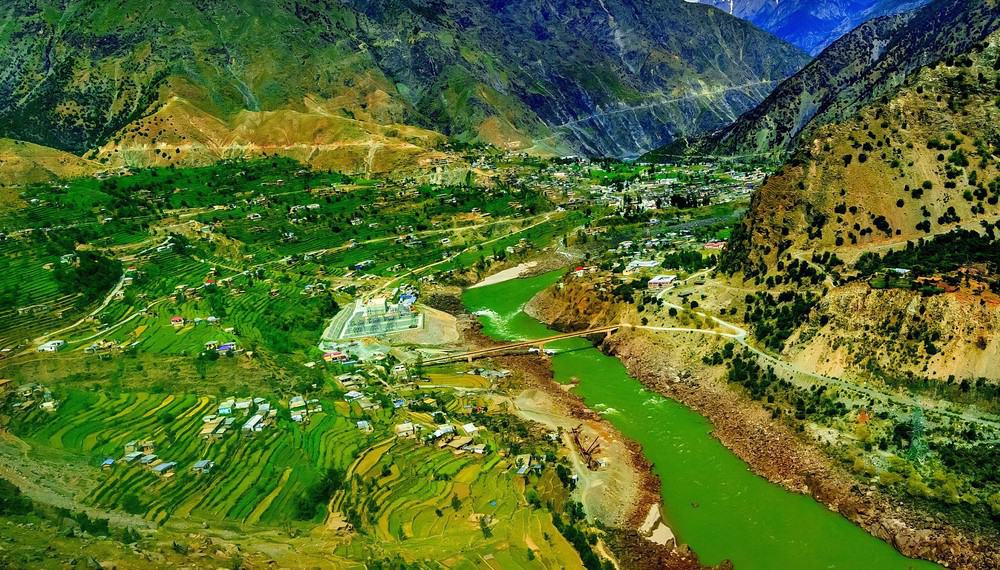
An aerial view of the Indus River valley in the Karakorum mountain range of the Basin. © khlongwangchao | Shutterstock
So how do we go about planning in a system that is in such constant flux?
Coping with system complexity in the Indus is the overarching theme of the third Indus Basin Knowledge Forum (IBKF) being co-hosted this week by the International Centre for Integrated Mountain Development (ICIMOD), the International Institute for Applied Systems Analysis (IIASA), the International Water Management Institute (IWMI), and the World Bank. Titled Managing Systems Under Stress: Science for Solutions in the Indus Basin, the Forum brings together researchers and other knowledge producers to interface with knowledge users like policymakers to work together to develop the future direction for the basin, while improving the science-decision-making relationship. Participants from four riparian countries–Afghanistan, China, India, and Pakistan–as well as from international organizations that conduct interdisciplinary research on factors that impact the basin, will work through a ‘marketplace’ for ideas, funding sources, and potential applications. The aim is to narrow down a set of practical and useful activities with defined outcomes that can be tracked and traced in coming years under the auspices of future fora.
The meeting builds on the work already done and, crucially, on relations already established in this complex geopolitical space, including under the Indus Forum and the Upper Indus Basin Network. By sharing knowledge, asking tough questions, and identifying opportunities for working together, the IBKF hopes to pin down concrete commitments from both funders and policymakers, but also from researchers, to ensure high quality outputs that are of real, practical relevance to this system under stress–from within and externally.
Scenario planning
Feeding into the IBKF3, and directly preceding the forum, the Integrated Solutions for Water, Energy, and Land Project (ISWEL) will bring together policymakers and other stakeholders from the basin to explore a policy tool that looks at how best to model basin futures. This approach will help the group conceive possible futures and model the pathways leading to the best possible outcomes for the most people. This ‘policy exercise approach’ will involve six steps to identify and evaluate possible future pathways:
- Specifying a ‘business as usual’ pathway
- Setting desirable goals (for sustainability pathways)
- Identifying challenges and trade-offs
- Understanding power relations, underlying interests, and their role in nexus policy development
- Developing and selecting nexus solutions
- Identifying synergies, and
- Building pathways with key milestones for future investments and implementation of solutions.
The summary of this scenario development workshop and a vision for the Indus Basin will be shared as part of the IBKF3 at the end of the event, and will help the participants collectively consider what actions can be taken to ensure a prosperous, sustainable, and equitable future for those living in the basin.
The rice that helps feed parts of East Africa plays a key global role–the challenge will be ensuring that this important trading relationship is not jeopardized by a system that moves from pressure points to eventual collapse. Open science-policy and decision-making collaboration are key to making sure that this does not happen.
This blog was originally published on https://wle.cgiar.org/thrive/2018/05/29/rice-and-reason-planning-system-complexity-indus-basin.
Note: This article gives the views of the author, and not the position of the Nexus blog, nor of the International Institute for Applied Systems Analysis.
Apr 26, 2018 | Communication
By Luke Kirwan, Open Access Manager at the IIASA Library
World Intellectual Property Day is celebrated annually on 26 April to bring a greater awareness of the role that intellectual property rights, such as copyright, patents, and industrial designs play in encouraging innovation and creativity. Unlike traditional property, intellectual property is intangible. It is far harder to protect one’s intellectual property from infringement or copying than it is to protect physical property. Intellectual property rights are important as, when well implemented, they provide the creator sufficient protection to benefit from their creation, but aren’t so stringent that they prevent widespread use.
Intellectual property refers to an individual’s original, intellectual creations, whether that is scientific, artistic, technical, or otherwise. As with other types of property, your intellectual property is covered by certain rights and protections automatically granted to the creator. These convey upon the owner rights over the control and utilization of their intellectual output. Depending on the situation, your intellectual property rights will also be covered by one or more types of protection, varying from patents to trademarks. These types of protection are intended to prevent unauthorized use or piracy of intellectual property, and to confer upon the creator time-limited, exclusive rights to their intellectual output.
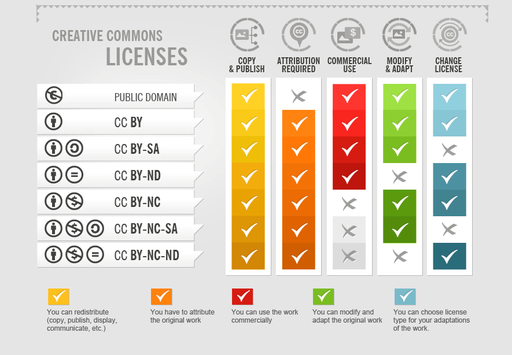
Creative commons licenses
When you write an article, that type of intellectual output is automatically covered by copyright. This is regulated through the Berne Convention. This convention confers a number of rights to the author, including the right to translate, make adaptations, and make reproductions of a work. Depending on the specific jurisdiction in which a work is created, copyright protection lasts for the lifetime of the creator plus a specific period (circa 50 to 70 years). In terms of producing a scientific article, one of the most important rights conferred upon an author by copyright protections is the right to sell or transfer these rights to another individual. Usually, when an author publishes an article with a journal, they sign a contract ceding their copyright to the publisher. Depending on the individual publisher, the author may retain some rights, such as the ability to distribute an earlier version of their paper and the right to proper attribution. However, the journal now has control of the dissemination, distribution, translation, and reproduction rights, among others.
Creative Commons licenses are designed to assist you in keeping your research openly accessible and distributable. For a creative commons license, the author retains all of the copyright, but has licensed their work for use and reuse under different circumstances, depending on the license. When publishing a paper under a creative commons license, rather than transferring the copyright to the publisher, the author instead licenses certain rights to the publisher to allow them to distribute the work. Creative commons licenses run from CC-0, which leaves a work completely free to reuse, redistribute, alter, and utilize in any manner, to CC-BY-NC-ND, which makes a work accessible, but restricts redistribution and commercial use. Similarly some license types employ an additional stipulation known as copyleft. In terms of a creative commons license this is known as share-alike. Essentially copyleft licensing allows people to freely distribute copies and modified versions as long as they adhere to the original licensing.
If you wish to make a paper open access, a journal will usually charge an Article Processing Charge (APC). However, the IIASA library maintains agreements with several publishers that allow a work to be made open access without charge. In instances where no waiver is in place, we also have an open access fund from which IIASA researchers can apply to have part of the APC charges paid for.
Note: This article gives the views of the authors, and not the position of the Nexus blog, nor of the International Institute for Applied Systems Analysis.
Mar 21, 2018 | Citizen Science, Environment
By Linda See and Inian Moorthy, Ecosystems Services and Management Program
A recent estimate indicates that there are around 3 trillion trees on the Earth’s surface, of which around 15 billion are cut down each year [1]. When we think of these vast numbers, we usually picture Amazonian rainforests or landscapes of evergreen trees surrounded by lakes and mountains. We rarely think of urban trees and the important role they play in making cities a healthier, greener place to live.

©Durch pecaphoto77 | Shutterstock
Raising awareness of the importance of urban forests for quality of life is part of the theme of this year’s United Nations International Day of Forests. At IIASA we are actively contributing to this awareness through an EU-funded project called LandSense. The aim of the project is to create a citizen-powered observatory for environmental monitoring of landscapes, particularly those that are changing and affecting citizen wellbeing, livelihoods, and biodiversity. Monitoring trees, and more specifically urban greenspaces, is a fundamental component of the LandSense project. Trees can reduce air pollution in cities by absorbing and filtering out the gases and particles that cause harm. Additionally, trees have a cooling effect on cities, which is increasingly important as temperatures rise due to climate change. In cities, the urban heat island effect results in higher temperatures during heat waves, often leading to health problems and even fatalities. Monitoring the presence of urban trees and fostering citizen access to urban greenspaces should therefore not be underestimated in terms of their contribution to promoting urban health, wellbeing, and sustainable cities.
With this urban focus in mind, the LandSense citizen observatory is engaging citizens in Vienna and Amsterdam in monitoring their local greenspaces, and in this way obtaining their perceptions about the quality and extent of these areas. A smart phone app developed at IIASA, guides participating citizens to specific locations in the city and asks them a series of questions, some of which relate to the quality of the trees in their area. This feedback can help city authorities to better understand the views of their citizens. The ultimate goal is to create dynamic and temporal maps of greenspace quality across the city, which can guide timely local decision making. The LandSense app will for example, directly contribute to STEP 2025, the urban development plan for Vienna.
This participatory approach not only gives citizens a better understanding of changing greenspaces in the city, but also empowers them to elicit action from city authorities in terms of improving poorly perceived greenspaces. By participating in this process, citizens are actively engaging in dialogue with the city authorities – getting their voices heard and influencing where future improvements will take place. Ultimately, by improving greenspaces and urban forests, citizens are helping to increase the wellbeing and quality of life of urban dwellers in the city.
We are currently testing the mobile app with students in Vienna and Amsterdam before launching broader citizen-based greenspace monitoring campaigns in the future. If you want to find out more, please visit the LandSense website for details or follow us on Twitter @LandSense.
References
[1] Crowther TW, Glick HB, Covey KR, et al (2015). Mapping tree density at a global scale. Nature 525:201–205. doi: 10.1038/nature14967
Note: This article gives the views of the authors, and not the position of the Nexus blog, nor of the International Institute for Applied Systems Analysis.
Jan 22, 2018 | Energy & Climate, Poverty & Equity
By Narasimha Rao, Project Leader of the Decent Living Energy (DLE) Project, IIASA Energy Program
Is there a conflict between reducing global income inequality and combating climate change? This seems like an odd question, given that these challenges have a lot in common. Raising the living standard of the poor for example, makes them resilient to climate impacts; less inequality can mean more political mobilization to establish climate policies; and changes in social norms away from material accumulation can reduce inequality and emissions. Academics have however been curious about the following phenomenon: In many countries, a dollar spent at higher income levels is less energy intensive than at lower income levels (known as “income elasticity of energy”). That is, rich people – although they consume much more in total – spend additional income on services or can afford energy-efficient goods, while the new middle class buy energy-intensive goods, like appliances and cars.
Many imagine China as a template for this type of fast growth. If globally significant, this effect would imply that growth that is more equitable would also be more emissions-intensive, and that we would have to pay particular attention to ensuring that climate policies reach the rising middle class in developing countries. While several studies have examined this phenomenon in specific countries, no one has examined its global significance. We set out to do that.
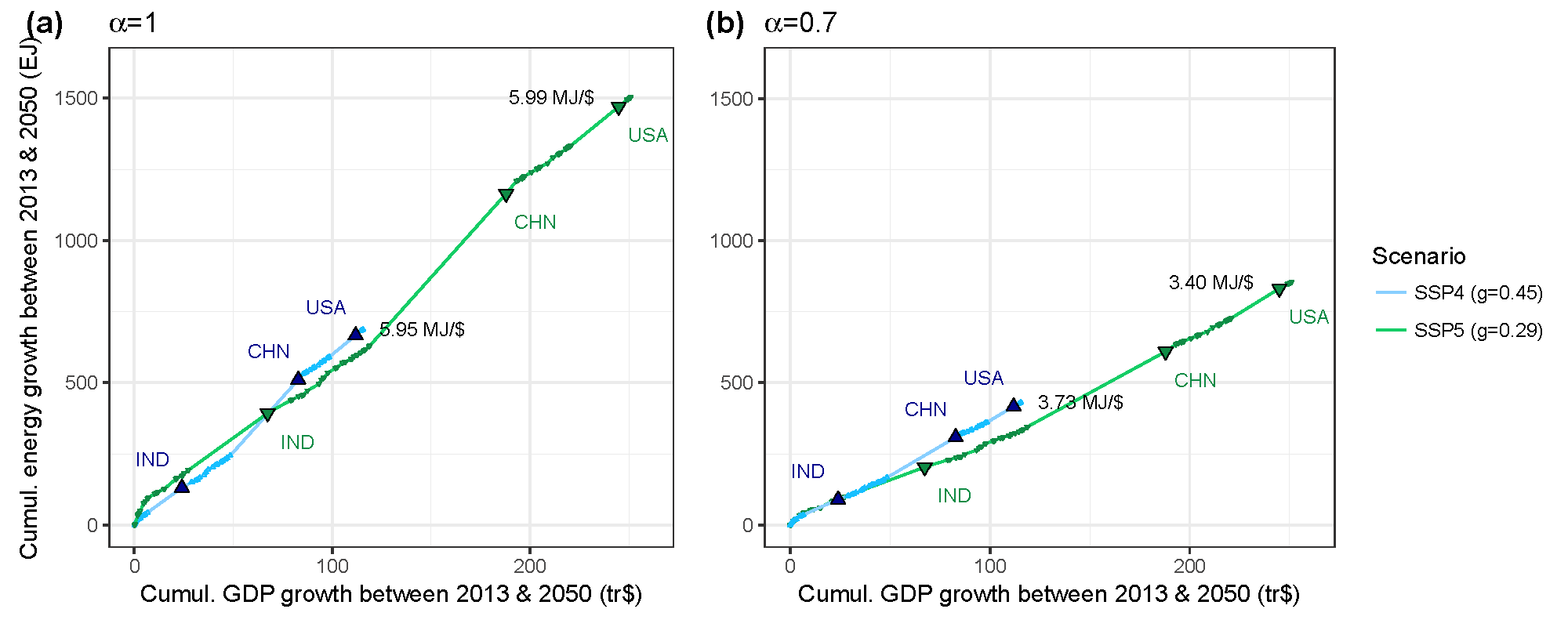
Energy intensity (MJ per $) lower in a high-growth, low inequality world (green line, Gini=0.29) compared to a low-growth, high inequality world (blue line, Gini=0.45). Gini reflects between-country inequality only.
Our analysis suggests that the energy-increasing effect of lowering inequality is more of a distraction than a concern. We compared scenarios of equitable and inequitable income growth, both within and between countries, assuming the most extreme manifestation of the income elasticity. Within any country, given the slow pace at which inequality typically evolves even with the most extreme known income elasticity and reduction in country inequality, greenhouse gas emissions would increase by less than 8% over a couple of decades. However, when one considers a more equitable distribution of growth between countries, global emissions growth may decrease when compared to growth that occurs in industrialized countries. This is because poorer countries have more potential for technological advancements that reduce the energy intensity of growth than richer countries do. That is, more income growth in poorer countries provides more opportunity for efficiency improvements that influence the emissions of very large populations. Furthermore, China is a poor model for poor countries at large, many of which have relatively low energy intensities, even today.
Climate stabilization at the level aspired to by the Paris Climate Agreement requires that we (i.e. the world) decarbonize to zero annual emissions around 2050, which means that even developing countries have to make aggressive strides towards integrating climate goals into development. Nevertheless, there is no sufficient basis for considering that equitable growth, and by implication the poor’s energy intensity, is part of the problem. To the contrary, the potential for co-benefits from equitable growth for climate change are enormous, but unfortunately under-explored, particularly in quantitative studies. Research should focus on quantifying the role of changing social norms – less consumerism, political mobilization, and other social changes that are typically associated with lower inequality – on reducing greenhouse gases.
Reference:
Rao, ND, Min J. Less global inequality can improve climate outcomes. Wiley Interdisciplinary Reviews: Climate Change. 2018;e513. https://doi.org/10.1002/wcc.513
Note: This article gives the views of the author, and not the position of the Nexus blog, nor of the International Institute for Applied Systems Analysis.

You must be logged in to post a comment.