Nov 10, 2015 | Demography, Young Scientists
By Anne Goujon, IIASA World Population Program
If you live in South Africa and did not complete high school then your chances of committing crime, being caught, and sent to jail are pretty high. This is what we can tell from comparing the education characteristics of the population of inmates in South Africa with that of the population who was not in jail. A recent study that I conducted with a team of African and European researchers in the framework of the Southern African Young Scientists Summer Program confirms some findings from previous research, such as this 2010 study that found that education has a statistically significant effect on crime.
South Africa spends about 8 billion dollars a year on public order and safety. Violence and related injuries are the second primary cause of death in South Africa, and in the last 10 years, the prison population rate has been in a range from 300 to 400 per 100,000 people, one of the highest rates in the world.

© straystone | Dollar Photo Club
South Africa is still plagued with the after-effects of its apartheid history, which enforced sub-standard education for different racial groups, creating a polarized society. The disparity in education between white and other racial clusters actually widened after the fall of the apartheid government. At the same time—and not unrelatedly, as shown by our study—the apparently peaceful transition to a democratic regime was accompanied by a rise of crime and violence, a gauge of the dichotomized South African society and its high levels of social exclusion and marginalization.
Indeed, our analysis of the 2001 census shows that the effect of education on criminal engagement – meaning in this study actually serving time in prison for a crime – differs by race. This suggests that there is an interaction effect between race and education. The negative relationship between being highly educated and the likelihood of being incarcerated is linear for respondents of mixed ethnic origin (or “colored” according to the South African classification), Indians, and to a lesser extent also for Africans. For white respondents, however, the effect of education creates a bell-shaped graph, with the richest and poorest people less likely to be in prison, and the medium levels of education associated with the highest probability to be in prison.
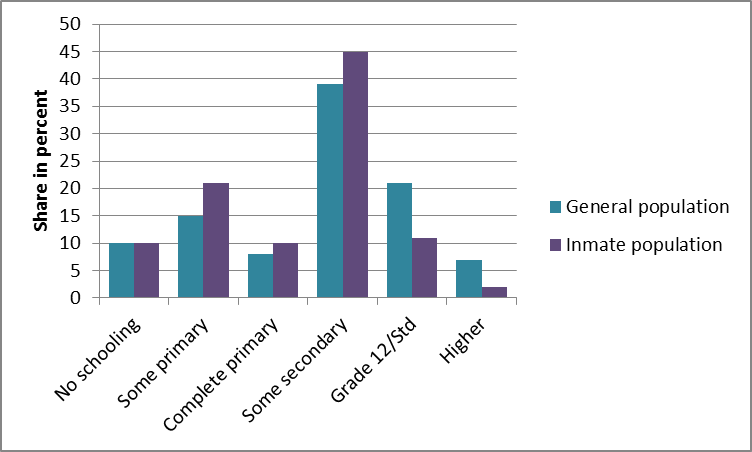
Share of the general and inmate population by level of educational attainment, South Africa, 2001
We also looked at the empirical results from a sample drawn in the Free State province—a crime hot spot – which indicated that a person’s native language, a proxy for race and place of origin, has a statistically significant influence on the likelihood to commit a contact . We also found that the probability of committing contact crimes, including vandalism, threat, assault, and injury, decreased with years of education, while the likelihood of committing economic crimes, including tax fraud, increases with years of education
This research provides another good incentive to invest in education in South Africa, and particularly to insist on all children completing upper secondary education finishing with grade 12. Education statistically significantly decreases the probability of engaging in criminal activity. Hence, it should be included in the National Crime Prevention Strategy, particularly in some targeted provinces within South Africa.
Reference
Jonck, Petronella, Anne Goujon, Maria Rita Testa, John Kandala, 2015, Education and crime engagement in South Africa: A national and provincial perspective. International Journal of Educational Development, 45: 141–151. doi:10.1016/j.ijedudev.2015.10.002. http://www.sciencedirect.com/science/article/pii/S0738059315001248
Note: This article gives the views of the author, and not the position of the Nexus blog, nor of the International Institute for Applied Systems Analysis.
Nov 5, 2015 | Systems Analysis
By M. Nazli Koseoglu, MSA 2015 Participant, School of Geosciences, Environmental Economics, Edinburgh University, Scotland

M. Nazli Koseoglu
The Summer Academy on Economic Growth and Governance of Natural Resources took place at Lomonosov Moscow State University from 20th July to 1st August 2015.
As an environmental economist working on economic valuation and optimisation of water use, the academy was very interesting for me. Water management is a dynamic process and requires bringing perspectives and expertise from different disciplines together. Application of systems analysis enables us to combine aspects from various domains, come up with models that identify nonlinearities, project regime shifts, and tipping points in the management of water as well as other natural resources. Such projects require interdisciplinary collaboration and communicable results to inform policy. Scientists need to translate their results to a language accessible to the policymakers, in order for society to pick up on and capitalize on the research efforts. The MSA 2015 provided me with necessary training to go deeper into different modelling methodologies, and learn the concepts and principles of science for policy first-hand from IIASA scientists.
The reading list sent before the course gave me the impression that I would probably be the only environmental economist amongst a crowd of mathematical modellers. However, arriving in Moscow, I found that the MSA 2015 participants came from a broad range of backgrounds and countries at different stages of their careers in academia or policy. We all came to learn and discuss the natural resource constraints to infinite economic growth on finite planet.
During lectures, the theoretical foundations of different mathematical approaches such as dynamical systems theory, optimal control theory and game theory were presented by leading scientists, such as Michael Ghil. Fundamentals of addressing challenges of natural resource management and comparing contemporary models of economic growth were also covered as central themes.
The course acknowledged the issues related with ecosystems services, public goods, inter-generational and international fairness, and public and common pool resource dynamics in the face of economic growth and resource constraints. The training underlined feedbacks between institutional dynamics and resource dynamics in complex social-ecological system and need for interdisciplinary and policy-relevant research, an important take-home message for next generation scientists.

Photos by M. Nazli Koseoglu
What makes the MSA so special?
Apart from lectures, we had tutorials, a group project, poster and project presentation sessions, as well as interesting talks on IIASA activities by Margaret Goud-Collins and Elena Rovenskaya, and an inspiring session on the importance of finding the right mentor for a successful career by Prof Nøstbakken. The MSA 2015 program had a good balance of theory and practice, which encouraged participants to be proactive and engaged.
I particularly liked the poster session. We presented our ongoing projects and received feedback from the lecturers and other participants. It was great to get comments and perspectives that I never thought of, and tips from senior researchers. In the late days of the academy we were assigned to prepare a group project on Artic systems which allowed us to put what we had learned at the lectures into practice and apply important topics outside our exact fields of study; in my case, these topics were petroleum economics and artic futures. I found the multi-disciplinary group work to be a great exercise for the development of my current study.
Attending the MSA 2015 provided useful training, both theoretical and practical, for understanding systems analysis approaches better. The host institution and organizing committee at Lomonosov Moscow State Univesrity provided impeccable hospitality, and the setting, in a landmark building in a landmark city, was a great perk. I received very constructive feedback, and made good connections around the world. I would recommend all early-career researchers in relevant fields to take this great opportunity next summer!
More information about MSA 2015

Participants in the MSA 2015. Photo Credit: M. Nazli Koseoglu
Note: This article gives the views of the author, and not the position of the Nexus blog, nor of the International Institute for Applied
Systems Analysis.
Nov 2, 2015 | Environment
By Ping Yowargana, IIASA Ecosystems Services and Management Program
Recently, Indonesia has been combating its most severe forest fire of the decade. Around 43 million Indonesians have been exposed to hazardous fumes, and countless loss of biodiversity and ecosystem services has occurred. An estimated 1 billion tonnes of carbon emission has been released to the atmosphere. Within three months, Indonesia’s daily carbon emission has surpassed the average daily emissions of the whole US economy.

Firefighters outside Palangka Raya, Central Kalimantan, 15 October 2015.
Photo by Aulia Erlangga/ CIFOR
Forest fires in Indonesia are closely related to unsustainable agricultural practices spreading out throughout the country. Indonesia is the world’s largest producer of palm oil, with 8 million hectares of plantation area. Other than its significant contribution to the economy, and broadly debated effects on the environment, oil palm is also regarded as a promising solution to the country’s effort to achieve energy security. The current administration has set ambitious targets to increase national biofuel production, and to consume it domestically.
In this landscape of uncertainty and crisis, scientific support for Indonesian energy policy is more urgently needed than ever. That’s why it is one of our main focuses in the IIASA Tropical Forests Initiative (TFI).
“Scientific authority has to be the basis of our future energy policies,” said Mr. Sudirman Said, Indonesia’s Minister of Energy and Mineral Resources, at the opening session of our first collaborative screening workshop in September in Bandung, Java. In the workshop, jointly organized by IIASA and the ministry, we aimed at laying out a plan to establish a new decision support system for the ministry, based on IIASA’s energy systems models such as the renewable energy systems optimization model, BeWhere and the Model for Energy Supply Strategy Alternatives and their General Environmental Impact (MESSAGE).
Scientific decision support systems (DSS) are a tangible crystallization of bridging science to policy. A decision support system gathers information and analytical expertise in order to improve the quality of policy making, using feedback and evaluation from previous planning and policy implementation. As a practical approach in dealing with what scientists refer as complex adaptive systems, such DSS should be able to integrate visions of long-term planning with technical details that are important for daily executed policies.

The IIASA and the Ministry of Energy and Mineral Resources of Indonesia screening workshop took place from 15-17 September. ©MEMR
Indonesia’s energy sector is a typical example of a highly complex system. Currently, challenges of the sector are more cross-sectoral than ever. Issues that seem to have limited scopes, such as bioenergy, actually influence a broad swath of other areas including agriculture, land use change, air pollution, climate change and social equity.
For that reason, the approach we brought to the recent meeting relies on multiple models. BeWhere brings a snapshot perspective to explore energy supply options that best meet the objective set by policy makers, such as cost efficiency or least CO2 emissions, based on location specific energy demand, resource and infrastructure availability. On the other hand, MESSAGE brings a more macroscopic perspective, looking at various scenarios that project optimal solutions of meeting long-term energy demand in a certain region or country.
To have a truly systems perspective, the above approach cannot stand alone. Before we started looking at Indonesia’s energy sector, we had engaged local researchers in the tropics to localize IIASA’s Gobal Biosphere Management Model (GLOBIOM). GLOBIOM is used to analyze the competition for land use between agriculture, forestry, and bioenergy, which are the main land-based production sectors. Clearly, investigating further into the energy system will allow us to grasp a more holistic understanding and develop solutions to tackle challenges in tropical countries.
As one of IIASA’s pilot countries in the budding TFI, Indonesia represents conflicting realities of the tropics, which are essential to the planet’s well-being. Tropical forests help regulate the Earth’s climate system, while being home to huge biodiversity, millions of plant and animal species. However, the region is also highly challenged by domestic development needs and the growing consequences of a globalized economy. Abundant natural resources and land-intensive agricultural commodities, together with intensified infiltration of global supply chains and complicated socio-economic structures, have resulted in severe ecological pressures that are harmful to the region as well as the planet.
The TFI aspires to address such complexity by applying systems analysis together with regional policymakers. Such application implies a two-fold challenge. The first one is to put together IIASA’s various scientific tools to understand the broader picture that comes out from the integration of interrelated aspects of domestic development. Secondly, working together with policymakers leads to a mutual learning process. Policymakers learn to use scientific models and tools in their decision making process. In this process, fitting the models into the local context is an inevitable step that requires intense communication between scientist and practitioners. Eventually, this process will also benefit researchers by giving them a better understanding of the issue, and opening opportunities for further scientific investigation on new topics.
Note: This article gives the views of the author, and not the position of the Nexus blog, nor of the International Institute for Applied Systems Analysis.
Oct 29, 2015 | Energy & Climate
Interview with Naoko Ishii, CEO and Chairperson of the Global Environment Facility (GEF), an independent organization that provides grants for projects working towards sustainability. IIASA, the GEF, and the United Nations Industrial Development Organization (UNIDO) have recently partnered on a new project to explore integrated solutions for water, energy, and land.

Naoko Ishii ©Global Environment Facility
Q What is sustainable development and why is it important?
A As Brundtland put it, sustainable development meets the needs of the present without compromising the ability of future generations to meet their own needs.
If we do not achieve sustainable development, we will fail to provide even the barest essentials of life—food, water, and shelter—for the growing population. The extra two billion people that will inhabit the world in 2050 can only be accommodated if we are serious about sustainable development.
On a personal level I care about sustainable development because I care about the future, I care about young people, and I care about humanity. Achieving sustainable development is, in my opinion, the single most important issue we face today. Without it, all life on Earth is in jeopardy.
The Global Environment Facility (GEF) was created on the eve of the 1992 Earth Summit in Rio to assist in the protection of the global environment and promote sustainable development. The benefits of such an endeavor have only become clearer over time. It is no coincidence that in 2015 all nations of the world will adopt a set of sustainable development goals which place a strong emphasis on the “global commons,” and that in parallel we have a new global agreement on climate change within reach.
How do you see the world in 2050? What are your most optimistic and pessimistic visions?
I am an optimistic person so I will say that, by 2050, every government, every business, and every individual will take the environment into consideration in all their actions. By 2050, we will all be caring for the Earth, taking responsibility for the use of our planet’s resources, and building economies which will leave no one without dignity or necessary subsistence. We will live within safe planetary boundaries. Pessimism is not an option for me.
How can science help the world achieve sustainable development?
Science plays a critical role. We need it to monitor the state of our resources, the impacts of our activities, and the progress being made. Science can also help identify solutions. It can help encourage businesses to make smart decisions, for example, about saving money though energy efficiency, risk mitigation, and new revenue opportunities driven by innovation and new business models.
Sustainable development is a truly cross-cutting endeavor: it spans many sectors, from agriculture to economics, and transcends national boundaries. Science can play an important role by producing research that is integrated, cross-sectoral and international. In this way, synergies, co-benefits, and trade-offs can be explored in order to identify the smartest paths to achieving multiple sustainable development goals at the same time

“Sustainable development is a truly cross-cutting endeavor: it spans many sectors, from agriculture to economics, and transcends national boundaries.” ©The GEF
How do you see the role of Global Environment Facility in implementing the Sustainable Development Goals?
The GEF is uniquely placed to support the global commons—the planet’s finite environmental resources that provide the stable conditions required for a sustainable, prosperous future for all. Our new strategy—GEF2020—lays out an ambitious vision for the GEF, aimed at addressing the underlying drivers of environmental degradation and delivering integrated, holistic, solutions. We are building on more than 20 years of experience providing support to over 165 countries. By working with national governments, local communities, the private sector, civil society organizations and indigenous peoples, we help find and implement integrated solutions to global challenges.
What are the advantages of a cross-sectoral and cross-border approach to identifying paths to sustainable development?
Many environmental challenges and threats to sustainable development do not respect borders. Moreover, they are often interdependent, or share common drivers. For example, biodiversity loss and climate change is partly driven by unsustainable forest management, which is in turn connected to production of globally traded commodities like palm oil or soy. Problems like this require an integrated, cross-cutting approach.
Given the importance of cross-sectoral interventions, at the GEF we will be implementing a program of integrated approach pilot projects. We believe that these will help countries and the global community in tackling underlying drivers of environmental degradation. I am also very excited about a research program we have recently launched in partnership with IIASA and the United Nations Industrial Development Organization, focusing on development and implementation of integrated solutions to tackle the water-food-energy nexus.
Note: This article gives the views of the interviewee, and not the position of the Nexus blog, nor of the International Institute for Applied Systems Analysis.
Oct 27, 2015 | Science and Policy
By Tanja Kähkönen, University of Eastern Finland, School of Forest Sciences & Institute for Natural Resources, Environment and Society
This autumn I attended the first joint JRC-IIASA Summer School on Evidence and Policy, which brought together policymakers and early-career scientists like myself to learn about the evidence-policy interface. After intensive days of interacting at lectures, learning together, and sharing views during the breaks, I can really say that as scientists we are operating in a different culture to policymakers.

Discussion and debate fostering greater understanding between researchers and policymakers at the JRC-IIASA summer school
This difference extends not only to what we do in our daily work, but also to what kind of language we use, how we communicate, and what level of certainty we give—or have to give—to the issues that we address. Often as scientists we are so intensively involved in our own work that we forget that communicating our research to policymakers cannot be done in the same way as communication with other researchers. This is because policymakers have different evidence needs, expected timeframes for information production, and level of discipline-specific understanding.
However, despite the different cultures, it is possible to learn to speak each others’ language and communicate more efficiently. Developing this communication was practiced throughout the course and a significant part of this took place during “masterclasses,” given by people who are themselves at the science-policy interface as part of their daily work.
I found the masterclass session on wicked problems and evidence-based policy, run by Jan Staman and Annick de Vries from the Rathenau Institute in the Netherlands, particularly attention-grabbing. They pointed out that apart from crises, for which policymakers need rapid evidence on specific topics, wicked—difficult to solve—problems such as creating climate change policy may face problems of scientific evidence overload, political dead-locks, and societal controversies.
The masterclass on uncertainty, risk and hazard, and the links to policymaking was also particularly eye-opening. Session leaders David Wilkinson and Jutta Thielen of the JRC suggested that a range of scenarios and consequences should be offered to policymakers in order to allow them to take better decisions under uncertain conditions in which risks of human loss or health hazard maybe high.
Other sessions focused on foresight, effective communication, using games for informing public and policy debates (crowdsourcing our search for solutions), big data, randomization, modeling, and the pros and cons of working at the science-policy interface—all very important topics for improving communication between scientists and policymakers.
All in all, I guess the take home messages of this course are different for each participant. As a scientist, the big messages for me came from the wrap up session in which “dos and don’ts” for evidence-informed policymaking were summarized by all the summer school participants. For the “dos” words such as trust, communication, providing clear and concise messages, being certain about something, keeping it simple, and understanding policy processes leapt out at me.
Despite the fact that the summer school lasted only three days, I am positive that it will have a lasting effect on the participants, opening a path for cross-cultural understanding between scientists and policymakers. Together improving communication to the benefit of our changing society.

Participants of the first JRC-IIASA Summer School on Evidence and Policy
Note: This article gives the views of the author, and not the position of the Nexus blog, nor of the International Institute for Applied Systems Analysis.




You must be logged in to post a comment.