Nov 10, 2015 | Demography, Young Scientists
By Anne Goujon, IIASA World Population Program
If you live in South Africa and did not complete high school then your chances of committing crime, being caught, and sent to jail are pretty high. This is what we can tell from comparing the education characteristics of the population of inmates in South Africa with that of the population who was not in jail. A recent study that I conducted with a team of African and European researchers in the framework of the Southern African Young Scientists Summer Program confirms some findings from previous research, such as this 2010 study that found that education has a statistically significant effect on crime.
South Africa spends about 8 billion dollars a year on public order and safety. Violence and related injuries are the second primary cause of death in South Africa, and in the last 10 years, the prison population rate has been in a range from 300 to 400 per 100,000 people, one of the highest rates in the world.

© straystone | Dollar Photo Club
South Africa is still plagued with the after-effects of its apartheid history, which enforced sub-standard education for different racial groups, creating a polarized society. The disparity in education between white and other racial clusters actually widened after the fall of the apartheid government. At the same time—and not unrelatedly, as shown by our study—the apparently peaceful transition to a democratic regime was accompanied by a rise of crime and violence, a gauge of the dichotomized South African society and its high levels of social exclusion and marginalization.
Indeed, our analysis of the 2001 census shows that the effect of education on criminal engagement – meaning in this study actually serving time in prison for a crime – differs by race. This suggests that there is an interaction effect between race and education. The negative relationship between being highly educated and the likelihood of being incarcerated is linear for respondents of mixed ethnic origin (or “colored” according to the South African classification), Indians, and to a lesser extent also for Africans. For white respondents, however, the effect of education creates a bell-shaped graph, with the richest and poorest people less likely to be in prison, and the medium levels of education associated with the highest probability to be in prison.
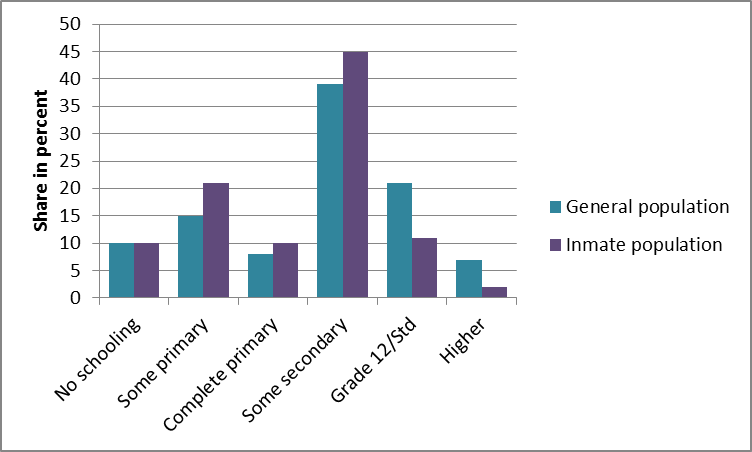
Share of the general and inmate population by level of educational attainment, South Africa, 2001
We also looked at the empirical results from a sample drawn in the Free State province—a crime hot spot – which indicated that a person’s native language, a proxy for race and place of origin, has a statistically significant influence on the likelihood to commit a contact . We also found that the probability of committing contact crimes, including vandalism, threat, assault, and injury, decreased with years of education, while the likelihood of committing economic crimes, including tax fraud, increases with years of education
This research provides another good incentive to invest in education in South Africa, and particularly to insist on all children completing upper secondary education finishing with grade 12. Education statistically significantly decreases the probability of engaging in criminal activity. Hence, it should be included in the National Crime Prevention Strategy, particularly in some targeted provinces within South Africa.
Reference
Jonck, Petronella, Anne Goujon, Maria Rita Testa, John Kandala, 2015, Education and crime engagement in South Africa: A national and provincial perspective. International Journal of Educational Development, 45: 141–151. doi:10.1016/j.ijedudev.2015.10.002. http://www.sciencedirect.com/science/article/pii/S0738059315001248
Note: This article gives the views of the author, and not the position of the Nexus blog, nor of the International Institute for Applied Systems Analysis.
Sep 9, 2015 | Alumni
Jesse Ausubel is director of the Rockefeller University Program for the Human Environment. He was a participant in one of the first classes of IIASA’s Young Scientists Summer Program (YSSP).
Please tell us about your current job – what is your major area of focus?
I do research and manage research. My research primarily concerns sparing natural resources through changes in technology and consumer behavior. The main projects I help manage are the Deep Carbon Observatory (concerned with the origins of life and hydrocarbons) and the International Quiet Ocean Experiment (aiming to achieve a better soundscape of the oceans, including human additions of noise).
In your recent paper, Nature Rebounds, you present a hopeful view of environmental change which contrasts with many other views of the future. What makes you think your view is possible?
The paper looks objectively at the peaking of demand for many natural resources that has occurred in the USA and elsewhere since about 1990. Demand for water, energy, land, and minerals is softening, while demand for information continues to soar. Fortunately, information brings precision in production and consumption and spares other resources. The result is, for example, huge regrowth of forests. The global greening, or net growth of the terrestrial biosphere, allows re-wilding. Ecological restoration inspires many people, although learning again to live in proximity to bears and wolves is not simple.

The American bald eagle population has recovered from endangered status. Photo: US Fish and Wildlife
What would be the key changes humanity would need to make for this vision to come true at a global scale?
Most of what happens is not because humanity consciously and deliberately strategizes and makes changes. The role of policy is vastly exaggerated. French intellectual Bertrand de Jouvenel wrote in his profound 1945 book, Du Pouvoir, “politics is the last repository of hope. “ High tech tycoons Steve Jobs (Apple) and Jeff Bezos (Amazon) popularized tablets and e-readers and did more, together with the innovators in e-mail, to spare forests than all the forest activists and UN targets. Good systems analysts find high leverage for sound directions like decoupling and recycling. Simply observing well, describing the world as it is, matters greatly and demands tremendous skill and dedication.

Ausubel wears the ribbon of the International Cosmos Prize, which he shared with other leaders of the Census of Marine Life program. Photo courtesy Jesse Ausubel
Please tell us about your YSSP work at IIASA? What were your questions, and what did you find?
I participated in the 1979 YSSP, the second class. IIASA’s energy group had developed scenarios of how human activities might change climate. My task was to explore impacts of climate and adaptations. The 1980 book Climatic Constraints and Human Activities summarizes much of what we learned. Most of the book still reads well. Following climate today, I am reminded of the remark, “Everything has been said, but not everyone has had a chance to say it.”
How did the YSSP influence your career?
My YSSP summer encouraged a big drop in my disciplinary and national prejudices. My chief, Soviet hydrodynamicist Oleg Vasiliev, had great intellectual integrity. We had a wonderful rapport and in fact in July I sent him best wishes for his 90th birthday. Oleg invited me to stay in Laxenburg for two more years, which opened more avenues, most importantly collaborations with Cesare Marchetti, Nebojsa Nakicenovic, and Arnulf Gruebler which continue today. The YSSP class itself was lively and talented; John Birge, for example, has had a great career in operations research. Finally, IIASA showed me the value of scientific cooperation between nations in conflict, and I have actively supported such cooperation ever since.
Reference
Ausubel, Jesse H. 2015. “Nature Rebounds.” Long Now Foundation Seminar, San Francisco, 13 January 2015. http://phe.rockefeller.edu/docs/Nature_Rebounds.pdf.
Note: This article gives the views of the author, and not the position of the Nexus blog, nor of the International Institute for Applied Systems Analysis.
Jun 30, 2015 | Young Scientists
By Benedict Singleton, IIASA Young Scientists Summer Program 2015, School of Humanities, Education and Social Science, Örebro University, Sweden
The first two weeks of the IIASA’s three-month long Young Scientist Summer Program (YSSP) are an exhilarating, if at times stressful experience. A quick-flowing series of events are scheduled including lectures, supervisor meetings, and drinks at a local vineyard.

The IIASA YSSP 2015 on their first day exploring Vienna. Photo by Siyuan (Kelsi) Yang
Prominent are the initial presentations, where all 50 students give four minute talks describing their work to their peers. The YSSP program is multidisciplinary, with representatives of many natural and social sciences. This made it challenging for me, because one is seldom sure of one’s reception outside of the comforts of one’s own disciplinary box: familiar terms become strange and theoretical givens can quickly become hotly contested points of debate. IIASA is interdisciplinary and international in scope and part of the idea behind YSSP is to promote collaborations across academic boundaries. This is a daunting task; many disciplines jealously guard their specific view on reality and the absence of a shared theoretical vocabulary can transform well-intended discussions into general bafflement. Thus, despite interdisciplinarity being of considerable importance to science (no discipline can grasp all of reality all the time), it remains a considerable challenge in practice.
My own YSSP research centers around cultural theory, which asserts that the diverse ways humans view the world can be classified within a fourfold typology: individualism, egalitarianism, hierarchical, and fatalistic. Without going into too much detail, cultural theorists argue different combinations of these four cultural types are at play in any given social situation (Thompson et al. 2006). It has been interesting for me to reflect upon IIASA strategies for promoting interdisciplinary work among YSSP participants even as I am subject to and cooperate with them.
Academics often struggle to cooperate effectively as the profession is structured to allow both considerable individualism and a clear hierarchy. In this it has been said to resemble a drug gang. Researchers have considerable freedom to guide their own work while at the same time there is considerable competition for funds and the few permanent positions available. There is also distinct ranking and differentiation, with each discipline largely defining the researchers’ identities and concerns. Within disciplines there are often hierarchies of positions and institutions, which exert authority over and gain the attention of researchers. In sum, pressure to meet expectations within one’s own field and gain credibility amongst one’s peers in one’s own subject actively works against building the kinds of productive relationships required for genuine interdisciplinary work.

Rite of separation: Opening presentations. (Source B. Singleton)
The YSSP seeks to deal with this by trying to foster social bonds between participants through what anthropologists would recognise as a rite of passage. According to anthropological theory, such rites encompass three stages: rites of separation (from society), the liminal phase, and rites of (re)integration. Rites of separation take participants outside of their normal social structure. In IIASA’s case, this consists of mandatory group attendance of welcoming lectures and seminars (where the specialness of the YSSP group is emphasised) and the initial presentations, which are taken very seriously. The ending of the YSSP rite of separation is then marked with a post-presentation social event. Participants then enter the second, liminal phase; group bonds form amongst participants, who are equal in their “betwixt and between” state – whatever their statuses and identities before or after the rite of passage (Turner [1969]1995). Communication between equals then becomes possible within the group. For YSSP this is the most important phase; having forged egalitarian bonds between participants, cooperation and cross-pollination of ideas becomes more likely. YSSP then concludes with a rite of integration, a final presentation symbolically marking the end of the summer and the return of the participants to ordinary social structures.
Does the ritual work? It’s hard to say and depends rather on the level of one’s ambition for interdisciplinary dialogue. Speaking personally, I have had several productive conversations and have been pleased to receive interesting suggestions from fellow YSSP participants and scholars from well beyond my disciplinary horizon. However this is balanced by several factors inhibiting wholehearted participation during the liminal phase. Firstly, for most YSSP participants the summer project is but one small part of a greater PhD program, concern for which trumps any desire to learn outside of one’s own discipline. Secondly, it is clear that within IIASA itself there are different interpretations of what ‘interdisciplinary’ means and indeed clear differences regarding the relative values of particular subjects and philosophies. This undermines efforts to break down hierarchical boundaries between scholars and encourages individualistic behaviour among YSSP participants. By the end of the summer it’ll be clear how much egalitarian interdisciplinary work was possible and how powerful a rite the YSSP actually was.

Rite of separation: Forging bonds at a heuriger. (Source B. Singleton)
References
THOMPSON, M., VERWEIJ, M. and ELLIS, R.J., 2006. Why and how culture matters. In: R.E. GOODIN and C. TILLY, eds, The Oxford handbook of contextual political analysis. Oxford: Oxford University Press, pp. 319-340.
TURNER, V., [1969]1995. The ritual Process. Chicago: Aldine Publishing Company.
Note: This article gives the views of the author, and not the position of the Nexus blog, nor of the International Institute for Applied Systems Analysis.
Feb 2, 2015 | Air Pollution, Alumni, Young Scientists
Jun Liu, a PhD student at the College of Environmental Sciences and Engineering in Peking University, Beijing, China, has won the annual Mikhalevich Award for her outstanding research as part of the 2014 Young Scientists Summer Program (YSSP) in IIASA’s Mitigation of Air Pollution and Greenhouse Gases research program.

Jun Liu, second from right, at the YSSP award ceremony in August 2014.
Could you tell me a bit about yourself? Where are you from and what do you study?
I’m a fifth-year PHD student from College of Environmental Sciences and Engineering in Peking University, Beijing, China. My major is Environmental Sciences. My main fields of scientific interest include source of air pollution, regional air quality modeling, mitigation policy and health effects of atmospheric air pollutants.
Why did you apply to the Young Scientists Summer Program?
For a long time before the YSSP, I had read many excellent research papers on the RAINS and GAINS model. It was developed at IIASA. I hoped to have chance to utilize the model in my research. At the same time, I was so lucky to learn about YSSP application from my supervisors when I was visiting in Princeton University in winter 2013. So I applied for the program.
Please tell me about your research project: What was the question you were trying to answer?
In the background of Russian-China gas deal signed in May 2014, we wanted to discuss and compare the potential air quality benefits for coal substitution strategies between power plants, industrial boilers, and residential cooking and heating activities.
What did you find?
We found that whereas more efforts were directed at the power sector, replacing coal in power sector is actually the least effective strategy to reduce pollutants emissions. Instead, coal substitution in the residential sector achieves the highest potential for emission reduction and air quality benefits.

Air pollution is a serious and growing problem in many areas of China. Credit: V.T. Polywoda via Flickr.
Why is this research important for policy or society?
As we know, China is facing serious air pollution problems. Replacing coal with natural gas is one of the important strategies to reduce this air pollution. Historically, the power sector is the largest coal consumer and receives highest priority for reducing coal use, but the residential sector is scarcely discussed. It is an urgent time for China to propose a rational and effective distribution plan across different sectors for our limited natural gas resources.
My study shows that informed decision making should direct strategies to maximize the air quality and human health benefits, rather than focusing on the control of coal consumption. From this perspective, the residential sector is more promising than power sector and industrial boilers.
How are you planning to continue this research when you return to IIASA?
I plan to finish writing papers for the natural gas scenarios and continue with other policy relevant work, such as potential role of agricultural ammonia emission in air pollution in China.
What was your favorite aspect of the YSSP and IIASA?
First, The YSSP encourages an interdisciplinary perspective and integrated method. Second, we have lots of opportunities to improve our research through discussions with our research teams, our supervisors at IIASA, and experts in other fields who are also at IIASA. Also we can communicate and learn from other YSSPers to improve our work. The three-month length of the program is highly productive and effective.
What was your favorite moment of the summer?
There were many moments: I particularly enjoyed the many discussions with my supervisors and my colleagues in my research program, the unforgettable trip with YSSPers to Hallstatt, Asia Day, and the awards ceremony.

Jun Liu, seated at left, and her colleagues in the Mitigation of Air Pollution and Greenhouse Gases research program
Jan 27, 2015 | Environment, Young Scientists
Danielle Haak, who recently completed her PhD from the Nebraska Cooperative Fish and Wildlife Research Unit and the School of Natural Resources at the University of Nebraska-Lincoln, has won the annual Peccei Award for her outstanding research as part of the 2014 Young Scientists Summer Program (YSSP) in IIASA’s Advanced Systems Analysis research program.
 Could you tell me a bit about yourself? Where are you from and what do you study?
I grew up in Milwaukee, Wisconsin (USA), and it was there I fell in love with the natural world. As a kid, my family and I spent weekends boating on Lake Michigan, and I’ve always been fascinated by lakes and the hidden world beneath the water’s surface. As an undergraduate, I spent a few summers in northern Wisconsin at a limnology research station, and this is where I realized I could actually make a career out of this fascination! I went on to get a BSc in Wildlife Ecology, a MSc in Biological Sciences, and I recently defended my PhD dissertation that focused on the energetics and habitat requirements of the invasive freshwater Chinese mystery snail. In general, I’m interested in aquatic invasive species and how their introduction affects ecosystem structure, functioning, and resilience.
How did you get interested in this subject?
I was drawn to aquatic invasive species during my undergraduate research. My first independent research project was on invasive crayfish in a northern Wisconsin lake; in addition to out-competing the native crayfish population, the invasive species suffered from a fungal disease outbreak, and we wanted to understand its prevalence throughout the lake. I also worked as a technician on a whole-lake study researching the efficacy of manual removal of an invasive crayfish species from another lake. It was a long-term project that successfully reduced the invasive rusty crayfish population enough that the native crayfish population was able to recover, and the entire lake underwent a drastic physical change as a result. These large-scale dynamics have always been appealing to me, and I knew it was something I wanted to pursue in my career. When I started my PhD at the University of Nebraska-Lincoln, our research group had just started a number of side projects on the Chinese mystery snail, and there was an obvious gap in our scientific understanding of the species; thus, it made sense to take advantage of this opportunity!
What was the question you were trying to answer in your YSSP research project?
My YSSP project built upon my dissertation topic but went in a slightly different direction. My YSSP supervisor, Dr. Brian Fath, and I wanted to utilize the already-established methods of social and ecological network analyses, but in a way that hadn’t been done before. Ultimately, we had two main questions. First, we wanted to investigate how the social dynamics of ecosystems can be integrated into ecological network analysis. And second, we wanted to use network analysis to analyze the ecological effects and movement of the Chinese mystery snail in the southeast region of Nebraska.
What did you find?
Because there were a few parts to this research, we had a number of different results. First, we were able to create directed networks of how anglers and boaters moved among a network of flood-control reservoirs. We also developed ecological networks specific to each of the 19 reservoirs included in our study. Both of these findings were relevant by themselves, but the cool part was how we combined them. We adapted the framework of infectious disease network modeling to simulate what would happen within the first 25 years after a hypothetical introduction. The human movements connecting reservoirs were equivalent to a disease’s transmission rate, and the individual population growth of the snail within each reservoir after an introduction was like a disease’s incubation time leading up to a threshold where that reservoir then became contagious. We started with 5 infected and contagious reservoirs, and after 25 years only 5 of the 19 reservoirs did not have the Chinese mystery snail in it. Finally, we identified three of the already-infected reservoirs where preventing snails from being transported out of them would be most critical as well as two susceptible reservoirs where preventing introduction of the snails would be most beneficial.

Chinese Mystery Snail. Photo: Wisconsin Department of Natural Resources, Doug Jensen
Why is this research important for policy or society?
Our preliminary results demonstrated that social and ecological network models can be used in tandem, which has the potential to address a number of complex policy and management issues. Additionally, being able to prioritize reservoirs based on how effective prevention efforts would be allows managers to focus their limited resources in places they would get the best return on their investment. I believe there is also a great deal of potential in using this combined model approach to assess the spread of other aquatic invasive species of concern as well as other types of disturbances.
How are you planning to continue this research when you return to IIASA?
I would like to work with Dr. Fath on refining some of my individual ecological network models, and possibly incorporating some of the additional social data that’s available to us. We also discussed possibly using the approach to look at other questions related to aquatic invasive species, but in different geographical regions and possibly with different software. One of the best parts of this project was coming up with so many questions on where we could go next, and I really enjoyed working with Dr. Fath and gaining a new perspective on the questions that interest me.
How did your time at IIASA affect your PhD research?
My time at IIASA refreshed my love of the scientific process, and I loved the flexibility in adjusting my project as I learned more and developed new questions. Ultimately, I ended up with an additional chapter for my dissertation and came home with a mostly-completed draft.
What was your favorite aspect of the YSSP and IIASA?
I loved so much about YSSP and working at IIASA, but the best part was probably the ability to meet other brilliant scientists and students from around the world. In addition to thought-provoking discussions on science and research, we also had some incredible discussions on life in other countries with drastically different cultures. The other students made the entire summer even better, and I’m so happy I was able to participate in such an incredible experience. IIASA has a truly unique work environment, and everyone made us feel right at home. It really was a dream come true, and I’m so excited about the opportunity to return and pick up where I left off. The only thing missing will be my fellow YSSPers! I wish we could all come back every summer!
What was your favorite moment of the summer?
I think my favorite experience was the end of summer workshop and dinner and dance that followed. I was so impressed during the initial presentations and it was great to hear about all the progress that was made in the short three months. Celebrating this progress with a night of dancing and dining was just the perfect ending to a great summer. It was a bittersweet farewell, but I think it cemented our friendships and was a great capstone to an already dreamlike experience!

Danielle Haak (right) and fellow YSSPer Adriana Reyes, at the end-of-summer awards ceremony.
Note: This article gives the views of the interviewee, and not the position of the Nexus blog, nor of the International Institute for Applied Systems Analysis.



You must be logged in to post a comment.