Jul 30, 2015 | Alumni, IIASA Network, Risk and resilience
By Bruce Beck, Imperial College London and Michael Thompson, IIASA Risk, Policy and Vulnerability (RPV) Program.
What do Arsenal’s Emirates Stadium in London, the now glorious heritage of Islington’s housing stock, and the cable-car system in Kathmandu for getting milk supplies to that city, all have in common?
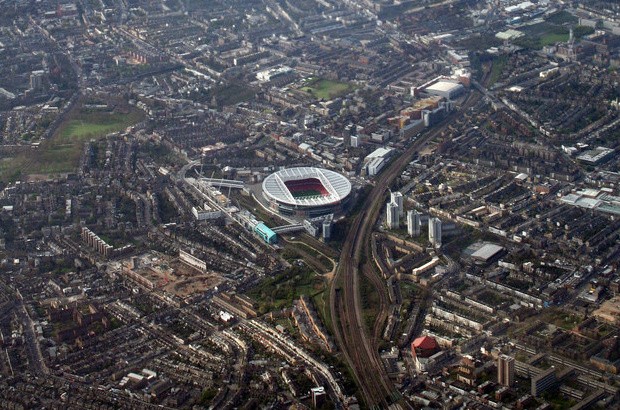
They are (or were) all transformative in their own way. All are commendable outcomes from the process of city governance that we argue will be essential for Coping with Change, the subject of our working paper for the Foresight Future of Cities project. Each is a primary case study in the analysis of our paper. We call this kind of governance ‘clumsiness’. It is something that does not evoke any sense of the familiar attributes of suaveness, elegance, and consensuality implied and valued in most other kinds of governance. So what, then, makes this thing with such an awkward, provocative name so relevant to the future of cities?

Before and after: Islington’s clumsy and resilient resurgence.
Imagine the city being buffeted about by all manner of social, economic, and natural disturbances over time. There will be times for taking risks with the city’s affairs, and times for avoiding them, or managing them, even just absorbing them – 4 mutually exclusive ways of apprehending how the world works, as it were, and 4 accompanying styles of coping.
In the financial industry, this risk typology has been referred to as the 4 seasons of risk. These are strategically and qualitatively different macroscopic regimes of system behaviour; coping with change between one and another of them is every bit as strategically significant. Conventionally, we recognise only 2 of these regimes: those giving rise to boom and bust in the economy. They reflect just 2 of the 4 ways of understanding the world and acting within it. The nub of the distinctive advantage of clumsiness over other forms of governance for coping with change and transformation is the richness of its (fourfold) diversity of perspective, from which may derive resilience and adaptability in the city’s response to any disturbance – big or small, economic, social, or natural.
Clumsiness is most assuredly deeply participatory. Its process is assiduously supportive of robust, noisy, disputatious debate: witness the gyrations in the Arsenal, Islington, and (especially so) Kathmandu case studies. This is exactly as one should expect of any meaningful engagement among the city’s stakeholders: the public-sector agencies, community activists, private-sector businesses, and so on, all with their own vested interests. The 4 ways of seeing the world are mutually opposed; each is sustained in its opposition to the others, as will be the shaping of their aspirations for the future. Each needs the challenges from the others, not least to avoid the ‘group-think’ in governance that is of such considerable concern to government in managing financial risk.
At the peak of deliberative quality in governance, all 4 outlooks are granted access and responsiveness in the debate, in the process of clumsiness, in other words, in coming to a decision or policy — with ever higher social consent. And in the clumsiest of outcomes, each opposing group gets more of what it wants, and less of what it does not want, at least for a while, until everything about the city’s affairs is revisited once again, as the various seasons of risk come around, each holding sway in turn. As we say in our working paper, clumsiness is why village communities in the Himalayas and Swiss Alps have remained viable over the centuries, without destroying either themselves (‘man’) or their environments (‘nature’) – sustainability par excellence, in other words.
So now we must ask: can cities be viable and sustainable in the same way as these mountain villages? In particular, how can the city’s built environment – the infrastructure that mediates between nature and man, the natural and human environments – be made resilient and adaptable, especially in an ecological sense? Thus might we possess this much prized attribute of systems behaviour in each of the natural, built, and human environments, and in a mutually reinforcing manner. What role might clumsiness have in all of this?
In closing our working paper, where we “connect the systemic dots” of our entire argument, we touch upon a computational foresight study in seeking a smarter urban metabolism for London. The fourfold typology of clumsiness is employed to define future target aspirations for the city (quantitatively expressed, under gross uncertainty). These should be the distant outcomes of the fourfold narratives of how the world is believed to work and what it is that each attaching vested interest much wants – and decidedly does not want. An inverse sensitivity analysis (redolent of a computational backcasting) identifies what is key (and what redundant) to the ‘reachability’ (or not) of each of the 4 sets of aspirations for the distant future. Imagine then the urine-separating toilet (UST) as the clumsy solution to a smarter metabolism for London – a smarter way, that is, of the city’s processing of the resource flows of water, energy, carbon, nitrogen, and phosphorus passing through its social-economic life. Rather more grandly put, imagine instead the UST as a “privileged, non-foreclosing policy-technology innovation” for today!
Well now … if clumsiness is such a jolly good thing, what else might it do for us and our cities? We submit it promises the prospect of greater resilience and adaptability in the governance of innovation ecosystems, extending thus the lines of evidence recounted for re-invigoration of the industrial economy of NE Ohio in Katz & Bradley’s recent (2013) book Metropolitan Revolution. ‘Resilience’ and ‘ecosystem’ are (for now) ubiquitous in our everyday language. But no-one, as far as we are aware, has thought of applying the immensely rich notion of ecological resilience to orchestrating the creative and clumsy affairs of an innovation ecosystem. We are currently examining this.
Read the full report
Featured image by Peter McDermott. Used under Creative Commons.
For further information on the Foresight Future of Cities project visit: https://futureofcities.blog.gov.uk
Jun 30, 2015 | Young Scientists
By Benedict Singleton, IIASA Young Scientists Summer Program 2015, School of Humanities, Education and Social Science, Örebro University, Sweden
The first two weeks of the IIASA’s three-month long Young Scientist Summer Program (YSSP) are an exhilarating, if at times stressful experience. A quick-flowing series of events are scheduled including lectures, supervisor meetings, and drinks at a local vineyard.

The IIASA YSSP 2015 on their first day exploring Vienna. Photo by Siyuan (Kelsi) Yang
Prominent are the initial presentations, where all 50 students give four minute talks describing their work to their peers. The YSSP program is multidisciplinary, with representatives of many natural and social sciences. This made it challenging for me, because one is seldom sure of one’s reception outside of the comforts of one’s own disciplinary box: familiar terms become strange and theoretical givens can quickly become hotly contested points of debate. IIASA is interdisciplinary and international in scope and part of the idea behind YSSP is to promote collaborations across academic boundaries. This is a daunting task; many disciplines jealously guard their specific view on reality and the absence of a shared theoretical vocabulary can transform well-intended discussions into general bafflement. Thus, despite interdisciplinarity being of considerable importance to science (no discipline can grasp all of reality all the time), it remains a considerable challenge in practice.
My own YSSP research centers around cultural theory, which asserts that the diverse ways humans view the world can be classified within a fourfold typology: individualism, egalitarianism, hierarchical, and fatalistic. Without going into too much detail, cultural theorists argue different combinations of these four cultural types are at play in any given social situation (Thompson et al. 2006). It has been interesting for me to reflect upon IIASA strategies for promoting interdisciplinary work among YSSP participants even as I am subject to and cooperate with them.
Academics often struggle to cooperate effectively as the profession is structured to allow both considerable individualism and a clear hierarchy. In this it has been said to resemble a drug gang. Researchers have considerable freedom to guide their own work while at the same time there is considerable competition for funds and the few permanent positions available. There is also distinct ranking and differentiation, with each discipline largely defining the researchers’ identities and concerns. Within disciplines there are often hierarchies of positions and institutions, which exert authority over and gain the attention of researchers. In sum, pressure to meet expectations within one’s own field and gain credibility amongst one’s peers in one’s own subject actively works against building the kinds of productive relationships required for genuine interdisciplinary work.

Rite of separation: Opening presentations. (Source B. Singleton)
The YSSP seeks to deal with this by trying to foster social bonds between participants through what anthropologists would recognise as a rite of passage. According to anthropological theory, such rites encompass three stages: rites of separation (from society), the liminal phase, and rites of (re)integration. Rites of separation take participants outside of their normal social structure. In IIASA’s case, this consists of mandatory group attendance of welcoming lectures and seminars (where the specialness of the YSSP group is emphasised) and the initial presentations, which are taken very seriously. The ending of the YSSP rite of separation is then marked with a post-presentation social event. Participants then enter the second, liminal phase; group bonds form amongst participants, who are equal in their “betwixt and between” state – whatever their statuses and identities before or after the rite of passage (Turner [1969]1995). Communication between equals then becomes possible within the group. For YSSP this is the most important phase; having forged egalitarian bonds between participants, cooperation and cross-pollination of ideas becomes more likely. YSSP then concludes with a rite of integration, a final presentation symbolically marking the end of the summer and the return of the participants to ordinary social structures.
Does the ritual work? It’s hard to say and depends rather on the level of one’s ambition for interdisciplinary dialogue. Speaking personally, I have had several productive conversations and have been pleased to receive interesting suggestions from fellow YSSP participants and scholars from well beyond my disciplinary horizon. However this is balanced by several factors inhibiting wholehearted participation during the liminal phase. Firstly, for most YSSP participants the summer project is but one small part of a greater PhD program, concern for which trumps any desire to learn outside of one’s own discipline. Secondly, it is clear that within IIASA itself there are different interpretations of what ‘interdisciplinary’ means and indeed clear differences regarding the relative values of particular subjects and philosophies. This undermines efforts to break down hierarchical boundaries between scholars and encourages individualistic behaviour among YSSP participants. By the end of the summer it’ll be clear how much egalitarian interdisciplinary work was possible and how powerful a rite the YSSP actually was.

Rite of separation: Forging bonds at a heuriger. (Source B. Singleton)
References
THOMPSON, M., VERWEIJ, M. and ELLIS, R.J., 2006. Why and how culture matters. In: R.E. GOODIN and C. TILLY, eds, The Oxford handbook of contextual political analysis. Oxford: Oxford University Press, pp. 319-340.
TURNER, V., [1969]1995. The ritual Process. Chicago: Aldine Publishing Company.
Note: This article gives the views of the author, and not the position of the Nexus blog, nor of the International Institute for Applied Systems Analysis.
Jun 23, 2015 | Energy & Climate, Science and Policy
By Hannes Böttcher, Senior Researcher, Öko-Institut, previously in IIASA’s Ecosystem Services and Management Program
In or out? Debit or credit? The role of the land use sector in the EU climate policy still needs to be defined
The EU has a target to reduce greenhouse gas emissions by at least 40% by 2030. This is an economy-wide target and therefore includes the land use sector, which includes land use, land use change and forestry. The EU is currently in the process of deciding how to integrate land use into this target. This is not an easy task, as we show in a new study.

Land use includes activities, such as logging, that can release greenhouse gases into the atmosphere. But the sector also includes other processes that can remove greenhouse gases from the atmosphere. Accounting for these processes is a complicated task. © Souvenirpixels | Dreamstime.com
The land use sector has several particularities that make it different from other sectors already included in the target, such as energy, industrial processes, waste, and agriculture. The most specific particularity is that the sector includes activities that cause emissions but also can lead to carbon being removed from that atmosphere, and taken up and stored in vegetation and soil. However, this removal is not permanent. Harvesting trees, and burning wood releases the carbon much more quickly than it was stored. Another particularity is that not all emissions and removals are directly caused by humans. This is especially true for removals from forest management.
In the past, the EU reported that uptake and storing of carbon through land use activities was higher than emissions from this sector. The European land use sector thus acted as a relatively stable net sink of emissions at around -300 to -350 Megatons (Mt) CO2 per year. But this might change in the near future: projections show the net sink declining to only 279 Mt CO2 in 2030.
Adding up carbon credits and debits
The emissions and removals that are actually occurring in the atmosphere are not exactly those that are currently accounted for under the Kyoto Protocol. Rather complicated rules exist that define what can be counted as credits and debits. Depending on how these rules develop, the EU sink may be accounted for to a large degree as a credit, or it could turn into a debit because the sink is getting smaller compared to the past. It is not likely that the entire sink will be turned into credits. Especially for the management of existing forests, which contributes a lot to the net sink, negotiators of the Kyoto Protocol have developed special accounting rules for the time before 2020. Under these rules, carbon credits only count if measured against a baseline.
The rules for the time after 2020 have not yet been agreed, however, as the Kyoto Protocol ends in 2020. In order to assess the impact of including the land use sector in the EU target in our new study, we had to make different assumptions, for example about how much wood we will harvest, the development of emissions and removals, and what the baseline for forest management should be. We then applied the existing Kyoto rules and alternative rules and assessed their impact on the level of ambition required to meet the EU’s target. It quickly became obvious: the assumptions we make and the rules we apply have very large implications for the 2030 Climate and Energy Framework.
One option of including land use discussed by the Commission is to take agriculture emissions out of the currently existing framework of the so-called ESD (an already existing mechanism to distribute mitigation efforts among EU Member States for specific sectors such as transport, buildings, waste and agriculture) and merge it with land use activities in a separate pillar. In our study we estimated the net credits that the land use sector could potentially generate, and found these credits could be as high as the entire emission reduction effort needed in agriculture. This would mean that in agriculture no reductions would be needed if the credits from land use were exchangeable between the sectors.
The impact on t he target of 40% emissions reductions can be more than 4 percentage points if land use is included and the rules are not changed. This means that the original 40% target without land use would be reduced to an only 35% target. Other sectors would have to reduce their emissions less because land use seems to do part of the job. The target as a whole would thus become much less ambitious than it currently is. But this does not need to be the case. If accounting rules are changed in a way to account for the fact that the sink is getting smaller and smaller, land use would create debits. Including debits in the target would make it a 41% target instead and increase the overall level of ambition. This would be bad for the atmosphere because effectively emissions would not be reduced as much as needed.
It thus all depends on assumptions and rules. Before the rules are announced, the contribution of the land use sector cannot be quantified. Given this, we argue that the best option would be to keep land use separate from other sectors, give it separate target and design accounting rules that set incentives to increase the sink.
Reference
Böttcher H, Graichen J. 2015. Impacts on the EU 2030 climate target of inlcuding LULUCF in the climate and energy policy framework. Report prepared for Fern and IFOAM. Oeko-Institut.
Note: This article gives the views of the author, and not the position of the Nexus blog, nor of the International Institute for Applied Systems Analysis.
Jun 10, 2015 | Risk and resilience
By Leena Ilmola-Sheppard, IIASA Advanced Systems Analysis (ASA) Program
Crisis management problems are getting more complex and complicated, but at the same time, governments have less and less resources for their management. How can research help decision makers plan for the unplannable?
Last week in Geneva, I took part in a crisis management workshop for national decision makers organized by the OECD High Level Risk Forum and the Swiss Federation Chancellor While the meeting was very specific to national security and crisis management, I found some takeaway messages that are relevant to us researchers as well, especially for those of us that hope that to help decision makers make better decisions through modeling.

Mads Ecklon, Head of the Centre for Preparedness Planning and Crisis Management of the Danish Emergency Management Agency, used the figure above as a framework to explain crisis management. His message can also be applied to the development of any social system. Picture 1 describes the standard starting point of the modeling exercise. We are modeling one behavior and then analyze how the system performance develops in a controlled situation. Ecklon explained that potential futures are not so predictable: the crisis in hand can either be solved, solved only partially, not solved at all, or in the worst case the problem may escalate (you never know how a social system will react in the crisis situation—a small incident can turn into a massive riot). The challenge for both national level crisis managers and modelers is same; you have to take all of these potential developments into a consideration.
But what happens if a new, unexpected crisis pops up while all attention is focused on the initial problem? Such hard-to-predict events are often referred to as “black swan events.” Eclon said that their team has more frequently been seeing situations where, when attention is focused on the current crisis, a new, different or related, crisis develops and no one notices it. For example, in the UK in 2007, just when all the crisis management resources were invested in flooding crisis, foot and mouth disease broke out among cattle. The new phenomenon, Ecklon claimed, is that these crises are piling up and even if they are independent from each other, the joint impact can be disastrous.

Modeling black swan events
I think that this message is important for modelers as well. We may be very happy to model all the four windows of our comic strip. But how can we include new surprises and crises into an ongoing model? We should develop models that include different development trajectories triggered by a change in one of our variables, but simultaneously we should be able to account for several overlapping surprises.
In the meeting, national risk managers spoke about ”unknown unknowns,” low probability high impact risks–strange unforeseen animals like a black swan that jump on the plate just when we think that the situation is in some kind of control.
This kind of modeling challenge is fascinating from an academic perspective, but researchers’ intellectual hunger should not be the only reason to develop methods for these kinds of situations. From decision makers’ perspective, this is exactly the case where useful models are needed. The multiple simultaneous developments of the complex systems are difficult to capture even for the brightest of the crisis teams, but a model could manage a job very well.
Most of the IIASA models are large, integrated models that cover global systems. These models are not designed for digesting black swan sandwiches. The Danish crisis management team has a solution worth for benchmarking for this problem as well. They have a specific small team that is called a Pandora’s Cell. Pandora’s Cell is dedicated to anticipating, imagining, and scanning for potential not-so-obvious developments that should be taken into consideration in decision making. This dedicated team is needed because all the other resources available have been focused on the obvious events, as described in the square one of our comic strip.

Black swan events refer to those that are unpredictable and difficult to plan for. © Wrangel | Dreamstime.com – Black Swan Photo
Jun 3, 2015 | Energy & Climate
By Nebojsa Nakicenovic, IIASA Deputy Director General/Deputy Chief Executive Officer (originally published in UNA-UK’s report: Climate 2020: Facing the Future)
Zero net global greenhouse gas emissions must become a reality before the end of the century if humankind is to stave off the worst effects of climate change. How can this be achieved?
This is a big year for embarking on transformational change towards a sustainable future for planet Earth. Three major global events are taking place, on financing and investments in Addis Ababa, sustainable development in New York and climate mitigation in Paris.
Energy futures are a major challenge on the way forward. In September the UN General Assembly in New York will focus on the Sustainable Development Goals (SDGs), which emphasise an enabling environment and economy for human development.
According to Kandeh Yumkella, Special Representative of the UN Secretary-General for Sustainable Energy for All (SE4All), the proposed SDG 7 on energy (‘Ensure access to affordable, reliable, sustainable and modern energy for all’) is “the golden thread that links poverty eradication, equitable economic growth and a healthy environment”.
SE4All calls for universal access to energy services, doubling the rate of energy intensity improvement and doubling the share of renewable energy, all by 2030. These goals are based on the Global Energy Assessment (GEA), coordinated by the International Institute for Applied Systems Analysis (IIASA) and the result of five years’ work by 500 experts worldwide.

The Paris climate meeting in December aims for a major climate agreement. What will it take? Photo Credit: Moyan Brenn via Flickr
The world is also going to have to introduce a workable, implementable scheme to stave off the possibility of runaway climate change, one with the objective of keeping the average global surface temperature increase to within 2°C over the pre-industrial average. It’s doable, but requires a high level of ambition to achieve immediate and vigorous emissions reductions.
The UN Climate Change Conference in Paris in December 2015 is aiming for – and will hopefully get – a climate agreement based on the 2°C limit that will be legally binding on every nation. To come near to achieving this target will require addressing energy systems, which is central to greenhouse gas emissions mitigation – 80 per cent of global energy is derived from fossil fuels. Limiting emissions will involve a major transformation of energy systems toward full decarbonization.
Stabilization scenarios
But we need to move urgently. IIASA research has shown that to meet the 2°C target and avoid dangerous climate change, emissions will need to peak by 2020. By 2050, they will have to be reduced by 30 to 70 per cent compared to today’s levels, and then they will need to go down to zero well before the end of the century.
The reason is that the amount of carbon that can be emitted in the future is limited if we are to restrict climate change to any given level. For example, to meet the 2°C target, humanity has a total carbon budget of some thousand billion tons of carbon dioxide.
This budget needs to be allocated along possible emissions pathways, which explains the need for achieving a peak as soon as possible followed by a decline to zero emissions. Should the emissions peak be late or decline rate too slow, humanity is likely to exceed the cumulative carbon budget. If this occurs, negative emissions would be required: namely, carbon removal from the atmosphere, so that excess emissions are offset rendering stabilization at 2°C possible despite an emissions overshoot.
The question is how could this be done. In stabilization scenarios, the negative emissions are achieved, for instance, by combining combustion of sustainable sources of biomass with carbon capture and storage (CCS). Both technologies are difficult from the current perspective and would require further development and vigorous deployment to reduce the costs and improve their performance.
CCS will presumably be developed anyway to decarbonize fossil fuels in those parts of the world where a transformation toward renewable, and possibly also nuclear, energy is delayed.
So we can decarbonize fossil fuels or switch to a higher percentage of carbon-free energy sources, such as many forms of renewable energy, to reduce and eventually eliminate emissions. What else can we do? GEA findings show that emissions could be reduced by up to half by efficiency improvements in energy, especially in end-use. This means looking at reducing emissions from areas such as transport, buildings, heating and cooling, urbanisation and electric appliances. It means changing mindsets, getting people and policymakers engaged in the emissions-reduction process.
Not all emissions come from sources that are judged to be a sign of development. In many developing countries, cooking over smoky fires burning traditional biomass (or coal) causes small particle pollution that adversely affects the health of women and children. IIASA research is analyzing how to introduce clean modern energy for cooking to millions of people and to cut indoor and outdoor pollution from these sources.
Improving air quality in cities with ground-level ozone, or smog (which results from chemical reactions between polluting compounds in the presence of sunlight), has clear synergies for human health, reducing cardiac, pulmonary and other diseases. It can increase human capital, too. One line of IIASA research shows that implementing a stringent climate policy could reduce globally aggregated lives lost due to indoor and regional air pollution by up to four million.
Sectoral interdependencies with respect to emissions are increasing. For example, reducing carbon and particle emissions to keep climate change in check has enormous implications for the food and water supply. Staggering amounts of water are needed to grow food but are also needed for sustaining energy systems. The productivity of land areas depends on climate and soil conditions. California is entering its fourth year of severe drought, raising concerns for agriculture and wildlife. Unsustainable water use in the state is draining aquifers containing ancient water that will take centuries to replenish.
All water systems – not simply those in traditionally arid or developing areas – are vulnerable to the changing climate. Reducing water use immediately reduces demand for electricity, as well as the fuels required to generate electricity. Water is needed to grow crops for biofuels, but fuel transport costs can be reduced by co-locating biofuel cultivation close to the communities that use them – another IIASA research result. Water can also produce plenty of hydroelectricity. Renewable energy technologies can be utilised to provide heat and electricity needs for water desalination. Water and energy use have almost boundless synergies and have to be analysed from an integrated perspective, which is why at IIASA examining the energy-water nexus is such a priority.
Complex problems
Stringent emission-reduction policies can also help to bolster the energy security goals of individual countries and regions. Such policies promote energy efficiency, the diversification of the energy supply mix and the increased utilisation of domestically available renewable energy sources. The result would be energy systems that are more resilient and simultaneously have a higher degree of sovereignty, especially compared to those so reliant on imports of fossil energy commodities, such as North America, Europe, Japan and, increasingly, China.
The international community has also woken up to the significance of climate-relevant emissions from deforestation and land degradation. The UN’s REDD+ initiative (reducing emissions from deforestation and forest degradation) is one of the more promising areas of agreement in global climate negotiations. Felling a tree always releases carbon, stored over its lifetime in its roots, leaves and branches. Large-scale deforestation therefore is a major contributor to carbon emissions. Nitrogen emissions from agriculture, wastewater management and industrial processes are also produced by human activities and need to be mitigated.

Felling a tree always releases carbon, stored over its lifetime in its roots, leaves and branches. Large-scale deforestation therefore is a major contributor to carbon emissions. Photo Credit: Curt Carnemark / World Bank
These are complex problems and huge investments are needed to solve the energy challenges society faces today. The ostensibly single aim of reducing emissions will, in fact, require a multiple paradigm shift affecting every domain simultaneously. There are many golden threads, and they are very entangled.
To fund the transformation to sustainable energy services for all, including the three billion ‘left behind’ without access and living at or below the poverty line, the Third International Conference on Financing for Development in Addis Ababa in July will need to dig very deep into its collective pockets. To transform the global energy system, the volume of investment will have to almost double over the next three to five decades, from about $1.3 trillion to some $2.5 trillion.
The money is available. Insurance and pension funds control $50 trillion. Governments can help catalyse other kinds of private investment by providing research and development and early deployment, and by helping to de-risk investment. The cost savings of these climate policy synergies are potentially enormous: $100-600 billion annually by 2030 in reduced pollution control and energy security expenditures (0.1-0.7 % of GDP) could be achieved by combining climate mitigation with combating air pollution rather than pursuing the two goals independently.
For emission reductions to be successful, these practical and financial considerations will need to be supported by a new ethical awareness that will temper our relationship with each other and our planet. Sustainability in every aspect of human life means a shift to equity and inclusion.
With the fast-growing population and the need for universal development, the requirement to control emissions is extremely urgent. The golden thread described by Yumkella with respect to the energy sustainable development goal encompasses the notions of both opportunity and fragility, but it binds us all.
Read the full publication: Climate 2020: Facing the future (PDF).



You must be logged in to post a comment.